PBS Hawaiʻi Presents
A Leader’s Journey: Rich Matsuda
Special | 24m 43sVideo has Closed Captions
The Hawaiʻi man leading the Keck Observatory atop Mauna Kea learns to balance science and culture.
The Hawaiʻi man who runs Keck Observatory atop Mauna Kea on the Big Island says his job is a great opportunity that comes with even bigger responsibility. Guided by cultural practitioners, Matsuda came to see Mauna Kea not simply as a summit with telescopes, but as a whole ecosystem, both scientific and sacred.
Problems playing video? | Closed Captioning Feedback
Problems playing video? | Closed Captioning Feedback
PBS Hawaiʻi Presents is a local public television program presented by PBS Hawai'i
PBS Hawaiʻi Presents
A Leader’s Journey: Rich Matsuda
Special | 24m 43sVideo has Closed Captions
The Hawaiʻi man who runs Keck Observatory atop Mauna Kea on the Big Island says his job is a great opportunity that comes with even bigger responsibility. Guided by cultural practitioners, Matsuda came to see Mauna Kea not simply as a summit with telescopes, but as a whole ecosystem, both scientific and sacred.
Problems playing video? | Closed Captioning Feedback
How to Watch PBS Hawaiʻi Presents
PBS Hawaiʻi Presents is available to stream on pbs.org and the free PBS App, available on iPhone, Apple TV, Android TV, Android smartphones, Amazon Fire TV, Amazon Fire Tablet, Roku, Samsung Smart TV, and Vizio.
More from This Collection
Veteran journalist Yunji de Nies shares the stories of 10 leaders from across the state. Each episode profiles one person, offering an in-depth look at their life, work, the struggles they have faced, the moments that shaped them and their vision for Hawaiʻi’s future.
A Leader’s Journey: Marisa Castuera Hayase
Video has Closed Captions
A leader in a philanthropic giant taps her Hawaiʻi roots and life experience to aid the community. (23m 57s)
A Leader’s Journey: Josie Howard
Video has Closed Captions
A woman from Micronesia leads a community-based group helping immigrants navigate life in Hawaiʻi. (23m 42s)

A Leader’s Journey: John Leong
Video has Closed Captions
From lava fields to leadership, John Leong built firms to restore both land and lives. (24m 12s)
A Leader’s Journey: Janice Ikeda
Video has Closed Captions
This Hilo native says solutions to problems exist here in lessons from the ʻāina and kupuna. (24m 28s)
A Leader’s Journey: Jack Kittinger
Video has Closed Captions
Persistence paid off for this leader who helped secure a first-of-its-kind green fee for Hawaiʻi. (23m 44s)
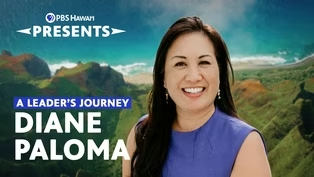
A Leader’s Journey: Diane Paloma
Video has Closed Captions
Diane Paloma’s story is one of resilience and strength, rooted in Hawaiʻi and guided by hula. (23m 59s)
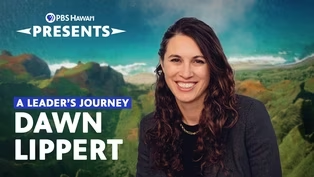
A Leader’s Journey: Dawn Lippert
Video has Closed Captions
Dawn Lippert sought to save energy from an early age. Now she helps others build a cleaner future. (24m 43s)
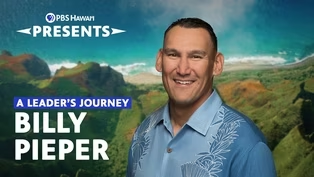
A Leader’s Journey: Billy Pieper
Video has Closed Captions
A homegrown bank executive looks to create opportunities for local residents to thrive. (23m 58s)
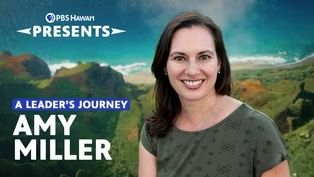
A Leader’s Journey: Amy Miller
Video has Closed Captions
Hawaiʻi’s Foodbank chief works to make a difference for thousands of residents who go without food. (23m 43s)
Providing Support for PBS.org
Learn Moreabout PBS online sponsorshipBeneath the pastures on the slopes of Kohala Mountain lie the seeds of Keawewai, once a 520-acre native ecosystem that sustained life across Hawai‘i island with food, medicine, and shelter.
The Kohala Center is working to restore balance to the land, and bring that forest back.
It’s a fitting place to meet Rich Matsuda, director of the W.M.
Keck Observatory, whose life’s work also seeks balance, weaving together engineering, science, culture and community.
You are the first Hawaiʻi-born director of Keck and I wonder what that means for you and what, what the significance is of that, do you think?
I think in one sense it, it, it doesn't matter, shouldn't matter, there's a job to do running the observatory, operating it to its best capability.
In another sense though, given where we are with Mauna Kea, and we're trying to find a path forward where astronomy is part of the Mauna, but in a more balanced way.
I think from that standpoint, it's really important.
I think having local leadership who has a really strong sense of community values at this time is really important.
Those values were instilled early in Nuʻuanu Valley on Oʻahu.
Grew up in Nu'uanu Valley, right where Nu'uanu Pali Road and old Pali Road fork, so pretty deep in the valley.
Grew up in a big family, family of six kids.
Very, at that time it was kind of like living in the country, because it wasn't in town.
A tributary of Nu'uanu Stream, ran right behind the house.
So that was my playground.
And my mom would, she wouldn't even know where I was.
I would be in the stream playing with my friends, catching crayfish.
And then we'd play and lose track of time and then we could hear her yelling, "Richard, come to dinner."
And I knew I would have to go back to the house.
What a wonderful way to grow up.
Yeah, it was really fun.
Yeah, so you go to Punahou.
What got you interested in engineering and ultimately into astronomy?
At Punahou, I don't think I was yet interested in engineering.
I was interested in fixing cars.
So, my friends and I would work on our cars.
And I never had enough money to buy a fast car, but some of my friends had saved up enough money, so we would go to the racetrack and work on each other's cars.
And that was a lot of fun.
So, I think in that sense, I was maybe inclined towards engineering and didn't realize it.
That inclination carried him to the University of Washington, where he earned a degree in electrical engineering, then spent nearly a decade in Seattle at Boeing.
In 1993, he faced a choice: remain in a secure career, or move his young family to Waimea to help build the second Keck telescope.
I had gone off to college, so four years in college, worked at Boeing for seven or eight years.
So almost a dozen years away from Hawaiʻi, I didn't realize how much I missed the ocean.
I still remember, because I came for the interview, and I was like, I don't know, should I move back home?
And then my sister invited me, who was living here on Hawai island, she invited me to go surfing the next morning after my interview and took me down to Waipio Valley, Dawn Patrol.
And I borrowed my brother-in-law's board and was paddling out, sitting in the water.
Just beautiful, had high waves, and the sun was rising out of the east, out of the ocean.
And the birds were chirping, and there was wild horses running on the Black Sand Beach, and I was like, This is incredible.
I think this is, you know, like a sign to come home.
What is it about the telescope or the race car, what is it about those complex systems, you know, an airplane that you find so compelling?
What makes you want to take them apart and put them back together?
I don’t know, I think it's the challenge of figuring out hard problems when there's not necessarily always a perfect answer.
So, you're always making trade-offs, so you might be trading off one set of performance characteristics against another.
And that's true with cars or airplanes or telescopes.
So, it may do one thing really well at the expense of other thing.
So you have to balance those things and come up with the right solution.
That sounds like an analogy for leadership.
I mean, how does that play in that kind of thinking of systems in that way?
How does that play into your leadership?
I bring an engineering mindset to problems in terms of trying to understand how the system works, what are the parameters and constraints.
And this could be people systems, mechanical systems or whatever.
The difference with leadership is, I think that the parameters are not only technical or numerical, right?
You have to think about belief systems.
You have think about the greater good for the collective or society.
And weigh those things, and those things don't always have numbers or measurements attached.
And so you can't only rely on your analytical capability.
You have also rely on things like your gut feel.
That balance between analysis and gut instinct would be tested on the mountain — when in 2019 the future of Mauna Kea put Rich at the center of one of Hawai‘i’s most divisive debates.
it was often portrayed as culture versus science.
To me, that's a false dichotomy, and in fact, it's a little bit offensive in that saying that there's no science in culture and there's not culture in science.
That's when A Leader's Journey continues.
Rich Matsuda came to Waimea thinking he’d stay three years.
More than three decades later, it’s where he’s raised a family and built a life.
When he needs to work through hard questions, he comes to this park in the heart of town.
I come here to Ulu La'au when I need to clear my mind and sort of connect to nature.
I also think it's, for me, a symbol of our community in Waimea.
That this place used to be pasture, and in just a couple of decades, it's been restored with endemic and native plants, and I think that it's a symbol to me that of the engagement of the community in Waimea.
You mentioned that you come here for difficult conversations that you wanna have outside of the office.
As a leader, why is it good, do you think, to do that in this kind of a space, as opposed to in a conference room?
I think in a conference room there's sort of a little bit of a script that you follow like in people's heads or my head of how you behave in a professional setting.
And sometimes the conversations need to go a little bit deeper than that.
And to me, changing the setting for those conversations helps to open up and allow a little bit more honest communication, vulnerability and I think nature just does that.
From here, Mauna Kea is in full view.
The summit that has shaped both Rich’s career and his greatest challenges.
In 2019, as conflict over the planned Thirty Meter Telescope reached its peak, he felt compelled to act.
So, I went up the chain at my observatory and said, this is, this situation is gonna change what we do forever going forward.
And having grown up in Hawaiʻi, you know, roots in Hawaiʻi with the values of Hawaiʻi, and seeing friends and even, you could say, family members and members from my community standing in resistance to TMT and in some cases, all of astronomy.
You were either on one side of the issue or another.
And to me, I didn't feel like that's how it should be, or that's the way it needed to be.
And that there was a lack of understanding and relationships that really, really troubled me.
And so even though I had no training or background in say community relations or dealing with the government or things like that, I asked to be involved.
Up to that point in time, I think my value to the organization or astronomy in general on Mauna Kea was my technical skill set.
And yet, I had this other side of me, my values, my relationships, my grounding in Hawaiʻi.
And I was able to bring those two parts of me together to work on trying to find a path forward for greater mutual understanding, greater relationship building, bridge building when it comes to Mauna Kea.
Yeah, would you say that that was your most challenging time as a leader?
It still is.
So, we're still in it.
And I would say, most challenging, the most learning, the most learning about Hawaiʻi, the more learning about myself, and the most rewarding work as well.
In what way?
Why would you say that?
The realization that we're all connected and that we may not see the world from the same point of view.
Like, we have different worldviews among us all.
And that if you can sit down with an open heart and an open mind, and try to understand different points of view.
And also share yours, that's like an amazing process, and I think that's a Hawaiʻi process through and through.
That's our history in Hawaiʻi, where people have come together and tried to understand each other and live together.
What was that like for you to be out there and to have you know, a lot of the community be angry with you and you're representing something that they don't like and that they don't want.
In the very beginning, my reaction was defensiveness because, you know, I'm so stoked about getting to work on this amazing telescope, and I'm thinking we're doing great things, studying science and sharing the knowledge with everyone.
And so, to have folks who are against that, I felt like, hey, how come, why is that happening?
And initially it took it personally and defensively, but once I decided I don't understand what's going on, I need to listen and try to understand better.
That defensiveness came down, my ears opened up, my heart opened up.
I think that we could do more of that instead of jump to conclusions and get angry with one another.
I think we should do more of trying to listen to each other, and it's something that my dad taught me growing up.
Was try to imagine yourself in the shoes of others and that everyone has value.
When you were having some of those tough conversations in 2019, and probably, I would guess, in the years since, what was the most difficult part of that for you, you know, this sort of feeling of, I wish they, if they could only understand this, maybe they would understand.
I know you talked a lot about how much you were listening, but what did you really hope that others understood about your position?
In the media, it was often portrayed as culture versus science, and to me, that's a false dichotomy, and in fact, it's a little bit offensive in saying that there's no science in culture and there's not culture in science if you separate that way, right?
What I wish is that people would see that the two things can not only exist together, but can integrate and uplift and make a sum that's bigger than the parts.
I want to ask you how your relationship with the mountain itself has changed in the time that you've lived in Waimea and worked on the mountain.
Probably the most significant change was in 2021.
There was a report that got done to the Department of the Land and Natural Resources to evaluate how the Mauna was being managed.
And one of the things that came out of that report was that the Native Hawaiian community had not been engaged or consulted enough.
So, this group was put together to try to figure out a new way.
In that working group were some cultural experts, including Auntie Pua Kanahele.
Auntie Pua talked about Mauna Kea.
So, in my mind, having built the telescope and everything, Mauna kea meant the summit where the telescopes were.
She talked about the Mauna as an entire ecosystem of natural elements, and how there are basically like laws of nature that if you observe you can understand.
Those explanations were deeply cultural and highly scientific, in terms of her understanding and sharing with us how it works.
And to this day, when I drive to the Mauna, where before I would look up and see, are the observatories in the clouds, how's the weather up there?
I look at the whole thing.
I think about the way the wind is blowing and the way the clouds are forming and the water cycle and where the water falls and where it must go and what does that provide for in the environment and things like that.
So, the evolution of my thinking about the Mauna has really expanded from that.
Still ahead, new uncertainties test Rich’s leadership and remind him why discovery matters.
The future of the Thirty Meter Telescope is unresolved.
For Rich Matsuda, there are new challenges that may be even more complex.
Without delving too deeply into politics, we do know that the administration, the current administration in Washington has different priorities than the last one, and that has had a big impact on science across the board.
I'm wondering how you're navigating this moment in science and science funding and the conversations that are happening.
It's a really tough situation.
It's the situation that I wish we weren't in, I think.
And it's affecting so many aspects of science, so beyond astronomy.
So, this is an issue for science writ large in terms of federal support and leadership.
The metaphor that I've been using is if we're sailing on a boat and we see a storm on the horizon, and that storm is coming towards us, and the boat is engaging the storm, you gotta handle the storm, but you also gotta think about where you're headed on the other side of that.
One of the leadership mindsets I do is to mentally go to the other side and look back to today and say, what would I tell those people?
What would I tell that community?
Definitely stick together.
Don't start fighting and tearing each other apart.
Be sure of what your priorities are, what's most important, focus on that.
It does feel like we are at such an inflection point when it comes to science that, you know, even before COVID, the conversations around science and facts and data were very different than fast forward to now where science itself and the value of science is being questioned.
And as someone who has spent his entire career in that field, what is that like for you?
It's just really, really disappointing, and at the same time, we cannot let that define us.
The tendency might be, you know, take shelter and clamp down.
No.
We've got to have strong, positive vision.
How do we do this, and how do we do it in even a better way?
In Hawaiʻi, we have such the opportunity for this.
The conflict around Mauna Kea has taught us so much.
If we just hunker down and care only about ourself because times are hard, then we're destined to have a bad outcome.
I'm curious what your thoughts are on what makes it easy to lead in Hawaiʻi and what makes it difficult.
So today, I went swimming at the beach.
I saw friends.
I went to the farmer's market.
I saw friends.
There is a sense of shared values, but there's also a shared accountability.
Like, my behavior is being seen by everyone in my community.
So, if I make decisions that are not in the community's interest, people are gonna know, and I'm gonna know that they're gonna know.
So, there's this sense of values grounding that I think makes it easy to lead The thing that makes it tough, I think, is we can be a little bit conflict-averse sometimes and very consensus-oriented.
And sometimes, things just need to change.
And when you're making big systems change, not everybody is ready for change at the same time.
What's difficult is knowing when to push forward, even though you may not have everyone on board yet.
But to take a step in the direction you believe.
And then help interpret that for everyone and see if you can help them move that way versus waiting, waiting, and waiting.
I know you're not an astronomer, but what do you love about the discovery piece of the work that you are a part of?
Just the expansiveness of it all.
I had a friend in observing.
So, you're seeing the images come into the telescope over the computer in the control room in Waimea.
And at the same time, Kīlauea was in one the eruptive cycles.
So, we had the YouTube, the live stream and the lava was shooting a thousand feet into the air.
At the same time, we were looking at lensed galaxies, so gravitationally lensed galaxies from the distant universe and taking the signature of the light from that galaxy and trying to understand the composition of what was in that light.
And we saw a signature of iron.
And this thing was an object that is so far away that the light left that object before Earth had even formed.
And we're only seeing it now.
And so he said, is that the same kind of iron that's coming out of the Kīlauea right now?
And we were like, yeah, isn't that amazing that iron, the element of iron is emanating from this galaxy that existed from before Earth was formed, and it's happening right now.
And so, like, these physical processes across like these enormous expanses of time and space are connecting us and we're here to see it at the same time.
It just makes you appreciate life on earth because so far it's the only intelligent life we know about even though the universe is so expensive and we've learned there's many, many planets around many, many stars out there it's ubiquitous.
But so far as we know the life we appreciate here on earth is the only form of that that we know of.
And so, it gives you a sense of cosmic humility, if you like, that what we have here is so incredibly special.
Being human, I think, is pretty unique.
And so, we should appreciate it.
What a gift.
My god.
Yeah.
I want to end, we always ask the same question and that is to ask, what's the best piece of advice that you've received in your life?
Part of what I did outside of work was coach basketball.
So high school girls basketball at Hawaiʻi Preparatory Academy.
A friend of mine asked me to coach.
And a piece of advice that was actually his team rule, and he said, be aware of how your actions affect others.
He didn't have a big, long rule list.
That was the only rule.
And, um what it said to me, uh, was simply that you're part of a bigger community.
And what you do, whether it's negative or positive, affects that community.
So, always keep in mind that any action you take is going to impact that community, and so, his voice is always in the back of my head when I make decisions, I try to think through who it affects and how it affects them.
From the summit of Mauna Kea to galaxies beyond our reach, Rich sees connection and understands that every action ripples outward.
For A Leader’s Journey, I’m Yunji de Nies.












Support for PBS provided by:
PBS Hawaiʻi Presents is a local public television program presented by PBS Hawai'i