
Feasting with the Matriarchs of Onondaga
Episode 3 | 15m 29sVideo has Closed Captions
Chef Pyet travels to the Finger Lakes region of upstate New York to visit the Onondaga Nation.
From 3,000-year-old pureed squash to hot-rock venison stew, in this episode of Spirit Plate, Chef Pyet travels to the gorgeous Finger Lakes region of upstate New York to meet legendary seed keeper Angel Fergusons and cook with Onondaga Tribal matriarchs to create a scrumptious 10-coarse meal, in a breathtaking celebration of Indigenous foodways.
From
Problems playing video? | Closed Captioning Feedback
Problems playing video? | Closed Captioning Feedback
Feasting with the Matriarchs of Onondaga
Episode 3 | 15m 29sVideo has Closed Captions
From 3,000-year-old pureed squash to hot-rock venison stew, in this episode of Spirit Plate, Chef Pyet travels to the gorgeous Finger Lakes region of upstate New York to meet legendary seed keeper Angel Fergusons and cook with Onondaga Tribal matriarchs to create a scrumptious 10-coarse meal, in a breathtaking celebration of Indigenous foodways.
From
Problems playing video? | Closed Captioning Feedback
How to Watch Spirit Plate
Spirit Plate is available to stream on pbs.org and the free PBS App, available on iPhone, Apple TV, Android TV, Android smartphones, Amazon Fire TV, Amazon Fire Tablet, Roku, Samsung Smart TV, and Vizio.
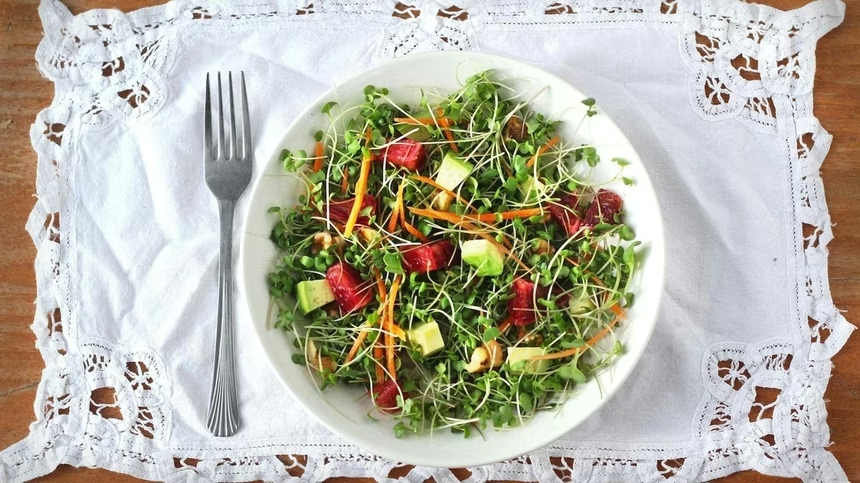
Find Cooking Shows Recipes And More
Discover why PBS is the original home to food and cooking content. From Julia Child to Lidia Bastianich to Pati Jinich, get the best recipes and shows from your favorite chefs.Providing Support for PBS.org
Learn Moreabout PBS online sponsorshipThis is everything we're going to cook today in our clay pots, our wooden trough.
we're going to make venison heart soup.
This pot is my magic pot.
No matter how many people show up to the event, it always produces enough food for everybody there.
And we're going to use hot rocks.
We're going to prepare wild rice And in this pot we're going to prepare our milkweeds with chanterelle mushrooms.
These were picked yesterday in the understory of the forest.
And you can find them along the edge of hemlock trees.
Any mushroom that you find could have a potential poisonous twin.
So you have to be careful.
You have to know your mushrooms before you pick them, Okay?
Know your trees.
Know your mushrooms.
Yep.
Or you could die.
I'm Chef Pyet Despain.
From winning the Next Level Chef to cooking for A-listers.
I've made my mark with Indigenous fusion cuisine.
I chased my dreams to LA but hit roadblocks.
I spent a year couchsurfing, searching for identity and direction.
What grounded me was food, the traditional Native American and Mexican recipes of my ancestors.
Now I'm on a mission across the Americas to reconnect with Indigenous foodways and bring their bold, beautiful flavors back to the table.
Today I'm in the beautiful Finger Lakes region of upstate New York to visit the ancestral land of the Onondaga Nation, Part of the Six Nations of the Haudenosaunee Confederacy.
The Onondaga people were, and still are, farmers.
The Three Sisters - corn, beans, and squash - are still staples of their diet.
I'm excited to meet Angela Ferguson, a leader in the Indigenous food sovereignty movement and keeper of the seeds of crops that have sustained all the nations for thousands of years.
I'm heading there to go check it out we're also going to be cooking a big feast for the clan mothers, which I'm really excited about.
The Onondaga Nation has this important matriarchal system within their traditions.
So we're going to treat the clan mothers with a very tasty feast.
First up, the Onondaga Nation farm, where Angela is tending a treasure trove of over a thousand indigenous seeds, some dating back 4000 years.
The mission to get each one back to its original home for replanting and revival.
So can we see the seed sanctuary now?
Yes.
We're heading to the second seed vault.
The main vault?
That one is sacred ground.
And off limits to cameras.
Each seed is treated like a living relative.
We weren't intending on stewarding so many different seed collections, but they come to us.
So they know there's good energy in this place.
They know we will protect it.
They know we will get it to where it's supposed to go.
And so that's always the mission, is to get all these seeds in the ground and reunite them with their home communities.
What's the oldest seed you've come across so far?
Well, we do have a corn in the Carl Barnes collection that is, over 4,000 years old.
And he himself planted that.
He took some seeds off of that cob and planted it, and it did grow.
That's crazy.
Scientists say that the seeds have a shelf life, but we don't believe that.
We have ceremonies, we have songs, and we have dances, and we have medicinal plants that can wake up the seeds.
So for us, there is no time limit.
So seeds that are thousands of years old have grown.
So, you know, they have their own little spirits.
And like even this one right here, we didn't have any more seeds of this particular one.
And then somehow this old variety made it back to us.
Sometimes it's referred to as grandfather or grandmother corn.
And so each individual seed is covered by four husks like baby blankets.
And it's really powerful because, this was the one of the original corns.
And we call that oneñha, which means the original corn.
A really, strong ancestral variety that came back to us.
And, each one of these varieties has a story behind it of how the seeds came to us.
Just like I feel very fortunate to be able to be in the presence of the ancestors and of those seeds.
And this is a truly a special gift that you have here.
Some seeds arrive from museum shelves, and others unearthed from ancient sites.
And each year they make thier way home.
If we truly want to believe that food is healing.
Food is medicine.
Food is kinship Food is something that we should respect and honor.
Each of these seeds have a story to tell, and it's up to us if we want to listen to it.
We're going to go berry picking!
For our meal for the clan mothers, we will be gathering most of the ingredients from the Onondaga Nation's 163 acre farm.
Is this where they determine who's a city girl and who's a farm girl?
Let's see your hands.
You can see mine are not that stained.
They were doing all the work.
Now, this farm is part of the same area that their people have been hunting, gathering and farming for thousands of years.
The burdock root and the entire plant is edible.
And helps feed the entire Onondaga Nation.
The chicory is edible.
Make chicory coffee out of the roots.
It's the end part.
That's sweet.
Right.
And that's what food sovereignty is all about.
Nurturing our traditional foods and utilizing that gift and returning it back to the community.
So ultimately what we're doing here is really learning how to eat with the land, not off the land.
We're just going to pick enough to make a nice dish for tomorrow.
Here we are - the milkweeds!
Monarch butterflies love the milkweed.
We would like to get these ones that are not flowered yet.
We would just pick the tops.
And if it has like a red veining, you don't want to pick those.
You can't eat those, huh?
No.
You can't eat those.
It's poisonous?
Yes.
Oh.
So the name milkweed comes from this milk that comes from the plant that you see here on my fingers.
And it is used traditionally, as a like a salve, if you will, for medicinal purposes.
You can kind of see it, my fingers sticking together.
Here's a little monarch larvae.
This is their food.
This is the only thing they eat.
So eventually those little larvae will eat the plant.
They'll eat those bottom leaves and then they'll become caterpillars.
And then they'll return to the plant when they're ready to become butterflies and lay their chrysalis.
Without the milkweed, there is no monarch butterfly.
And I think that concept is just like so beautiful and profound.
So normally, we only pick one third and leave the rest for the butterflies and the deer.
And we're not picking the root.
So of course it's going to grow back.
With foraging complete, it's time to move on to Angela's outdoor kitchen.
And we'll come over here and get some water.
The wild rice in there.
We have the clan mothers to feed.
And I never have measurements, I just know how it's supposed to feel.
Angela is part of a movement to bring back traditional Onondaga cooking methods.
She tells me that when European brass kettles arrived, the Onondaga people set aside their clay pots and with them a centuries old tradition nearly disappeared.
The Onondaga people are the keepers of the fire.
Cooking with the clay pots really brings us back to utilizing the elements around us.
And bringing that ancestral relationship into your cooking.
It's already starting to boil a little.
It's already cooking stuff.
Clay pots cook food slowly and evenly, making food more moist, tender and flavorful.
And actually more nutritious too.
I think I've learned four important things in less than 15 minutes of cooking with Angela.
Rule number one with your corn mush: Don't tap your clay pots with your spoon.
Then we're going to make a dish called samp which will have tuscaro white corn mush, mixed in with grandmother squash.
This next dish I'm so excited about.
Made with an ancestral squash that was lost and then rediscovered.
It's an amazing story - the seeds came out of a clay pot that was at an archeological site in Wisconsin.
And they were estimated somewhere between 8 to 1200 years.
They're about this big.
They're huge.
They divvied up the seeds between, the Ojibwe people, the Haudenosaunee people, and I believe the Ho-Chunk people.
We received six.
So we grew three of them the first year and we got three squash out of it.
Wow.
We were able to bring it back.
So we've shared those seeds with everyone in our Haudenosaunee Confederacy.
I can't wait to eat that squash.
I'm just going to savor every single bite.
Got to try it.
Let me see.
It's literally amazing.
Whoa!
That is so good.
It's so good.
Very unique flavor.
Yeah.
It's earthy.
Okay, so these are the milkweeds.
They've been soaking all day.
The mushrooms, the clay pot and the fire itself will give this milkweed dish a smoky umami flavor.
Alright.
You're also going to add in the fiddle heads.
They look amazing.
It looks so pretty.
Next some Indigenous magic.
These rocks are going to be heated to almost a thousand degrees to cook up a delicious venison heart stew.
It's kind of like, I call it Indigenous pressure cooking.
Because the water will instantly boil once we drop those rocks in there.
And the food cooks in minutes.
Fire, clay, stone and now wood, Angela brings cooking back to the elements.
She's helping to revive the craft of making these big wooden troughs.
Okay, so we're going to be dumping the corn.
Now, hunters bring home slabs of wood for tribal woodworkers.
Yellow squash and zucchini.
Everybody's cooking this way again.
Last, we have ramp leaves.
This is tons of fun.
A quick stir and the stew is ready for those hot rocks.
A little bit, yeah.
There's going to be a little bit of ash but that's okay.
I told you ashes is part of our our diet.
The aromas from the steam smells delicious.
Hot venison heart facial!
Elements from the earth.
You can see the meat is already turning brown.
What is the heart taste like?
Is it like minerally or like iron?
Yeah, a little bit.
It tastes like a cross between a liver and like, a really good, back strap steak.
Okay.
We love back strap.
Most tender part of the animal.
Yeah it is, it's very tender.
To fully cook the stew, will need another round of rocks heated up and then dropped back in.
I was just thinking about that connection to land.
That connection that we're trying to rebuild here.
That's that connection that a lot of people are missing from the foods they eat.
It does taste very like minerally.
Like... It's from the rocks and the organ meat.
Tastes like heart.
So now we're going to do the salmon.
Listen, I've cooked salmon a lot of different ways.
I've smoked salmon.
Salmon on the redwood sticks.
You know, filet it up and pan sear it in a pan.
Roast it.
But I've never cooked salmon on a hot rock before.
Go get the maple syrup.
And I'm excited to eat that salmon.
The Onongada nation leases sugar maple trees to give maple syrup to all the clan families.
That caramelization of the maple is really going to... I know.
The color.
Look at the color.
It's looks beautiful.
They believe maple sap is a gift from the creator.
A sweet reward after the challenges of a long winter.
I'm very happy.
Overwhelmed with joy.
Super grateful to be here.
Honored to learn these cooking techniques.
And just really feel connected to not just Angela and everyone here, but the food.
It's a very spiritual experience, so I feel very enlightened, if you will.
Not to sound cheesy.
Being here feels like I'm at home.
It's that knowledge exchange of her teaching the younger generation, which is me, and then we can then on together continue to teach people, you know, in our different walks of life.
I get to take that knowledge with me and that sense of patience and that sense of gentleness and intentionality with me on my journey, and go teach those that come after me.
So we have the clan mothers that are coming to eat the meal that we harvested and that we're cooking together in the kitchen.
This is samp.
So it's white corn mush mixed with squash and maple.
To be here is a gift.
And to receive that kinship and that friendship that they're offering me.
So this is a way of me giving back.
And part of expressing that gratitude, for me, is making a spirit plate.
A little of each dish to set aside to honor the ancestors, to give thanks for the food.
For the seeds.
For the people who came before us.
Thank you for those stories and for letting me be a part of them.


- Science and Nature

A documentary series capturing the resilient work of female land stewards across the United States.












Support for PBS provided by: