
May 4, 2026 - PBS News Hour full episode
5/4/2026 | 57m 46sVideo has Closed Captions
May 4, 2026 - PBS News Hour full episode
May 4, 2026 - PBS News Hour full episode
Problems playing video? | Closed Captioning Feedback
Problems playing video? | Closed Captioning Feedback
Major corporate funding for the PBS News Hour is provided by BDO, BNSF, Consumer Cellular, American Cruise Lines, and Raymond James. Funding for the PBS NewsHour Weekend is provided by...
May 4, 2026 - PBS News Hour full episode
5/4/2026 | 57m 46sVideo has Closed Captions
May 4, 2026 - PBS News Hour full episode
Problems playing video? | Closed Captioning Feedback
How to Watch PBS News Hour
PBS News Hour is available to stream on pbs.org and the free PBS App, available on iPhone, Apple TV, Android TV, Android smartphones, Amazon Fire TV, Amazon Fire Tablet, Roku, Samsung Smart TV, LG TV, and Vizio.
Providing Support for PBS.org
Learn Moreabout PBS online sponsorshipAMNA NAWAZ: Good evening.
I'm Amna Nawaz.
Geoff Bennett is away.
On the "NewsHour" tonight: Iran fires on commercial vessels and American warships, as the U.S.
launches a new mission to reopen the Strait of Hormuz.
The Supreme Court temporarily restores nationwide access to a widely used abortion pill.
And cuts at the U.S.
Forest Service raise concerns about its ability to protect public lands and fight wildfires.
MIKE DOMBECK, Former Chief, U.S.
Forest Service: They're working with a lot of uncertainty and lower morale.
And that's not the way you go into an intense fire situation.
(BREAK) AMNA NAWAZ: Welcome to the "News Hour."
The tenuous truce between the U.S.
and Iran was tested today, as American ships clearing a lane in the Strait of Hormuz came under fire and sank Iranian boats.
Also today, Iran fired drones and missiles at a key oil terminal in the United Arab Emirates, spooking markets and raising concerns that the war could resume.
Nick Schifrin begins our coverage.
NICK SCHIFRIN: Today, the war in Iran threatened to reignite.
The Islamic Revolutionary Guard Corps, or IRGC, fired missiles and drones and deployed small speedboats like these to attack U.S.
guided missile destroyers trying to clear Iran's choke hold in the Strait of Hormuz.
And the U.S.
fired back, said the military's top Middle East commander in a briefing to reporters.
ADM.
BRAD COOPER, Central Command Commander: The IRGC has launched multiple cruise missiles, drones and small boats at ships we are protecting.
We have defeated each and every one of those threats through the clinical application of defensive munitions.
NICK SCHIFRIN: Those munitions used by jets, ships and more than 15,000 service members conducting Project Freedom.
It's designed to clear a lane through which dozens of ships currently stuck can pass through the strait under a defensive umbrella, which a U.S.
official compared to zone defense, rather than the man-to-man defense of an escort.
ADM.
BRAD COOPER: We have multiple layers that include ships, helicopters, aircraft, airborne early warning, electronic warfare.
We have a much broader defensive package than you would have ever if you were just escorting.
NICK SCHIFRIN: Iran's campaign in the strait has damaged nearly 30 vessels since the start of the war, their charred and rusting remains littering the strait and ensuring Iran's choke hold.
Today, two U.S.
destroyers entered the strait and two U.S.-flagged commercial ships passed safely, the U.S.
goal to convince shipping and insurance companies they too can send their vessels through the strait.
ADM.
BRAD COOPER: Over the last 12 hours, we have reached out to dozens of ships and shipping companies to encourage traffic flow through the strait consistent with the president's intent to help guide ships safely through the narrow trade corridor.
This news has been quite enthusiastically received, and we're already beginning to see movement.
NICK SCHIFRIN: But for the first time since the cease-fire, Iran today resumed its attacks on Gulf oil infrastructure, striking Fujairah, the United Arab Emirates' only major port that bypasses the Strait of Hormuz.
The British military also reported two ships off the coast of the UAE on fire.
And Iran's Foreign Ministry spokesman served this warning to vessels in the strait: ESMAEIL BAGHAEI, Iranian Foreign Ministry Spokesman (through translator): Ships, ship owners and shipping companies are well aware that ensuring their safety and security requires coordination with the relevant authorities of the Islamic Republic of Iran.
NICK SCHIFRIN: As for diplomacy to end the war, this weekend, Iranian state TV released a new 14-point plan, requiring the U.S.
once again to pause any negotiations over its nuclear program and lift its blockade before Iran would release its choke hold over the strait.
This weekend, President Trump wrote: "Iran has not yet paid a big enough price."
And, tonight, following Iran's attacks, the U.S.
military remains poised to resume the war if the president orders them to do so.
President Trump threatened today that if Iran fires on U.S.
vessels -- quote -- "They will be blown off the face of the earth."
For perspective on the U.S.
effort in the strait, we turn to Ian Ralby, president of Auxilium Worldwide, a nonprofit organization that focuses on ocean governance and maritime law and security.
And retired Rear Admiral Andy Loiselle had a 35-year career in the Navy and has extensive experience operating ships and aircraft in the Middle East.
He's now with a military consulting firm.
Thanks very much, both of you.
Welcome back to the "News Hour."
Ian Ralby, let me start with you.
How are these shipping and insurance officials that you spoke to today responding to Project Freedom, and are they willing now to send their ships through the strait?
IAN RALBY, President, Auxilium Worldwide: Well, I think it's hard to garner any great degree of enthusiasm, when so many of the statements over the last few months have been met with reality at a very different point.
In other words, there has been a lot of enthusiasm behind announcements in the past that the strait was open, that things were going to be over in a couple of days or two weeks, and here we are.
And so I think many of them are skeptical and, at the same time, very cautious because, at the end of the day, human beings' lives are at stake.
These are not just big hunks of metal.
They're moving with people on board.
And so what we're risking is both the loss of those lives, as well as the potential for a catastrophic environmental situation that could become detrimental to the passage through the strait itself if one of these vessels were to entirely be blown up or sink and spill.
And so this is not something that is being seen as being the end of the situation.
It is potentially the next step.
But we're far from the confidence needed to have a mass exodus or a return by other ships that are looking to come into the Gulf.
So this is far from over.
NICK SCHIFRIN: So, far from the confidence of having a mass exodus, but Admiral Cooper, the Central Command commander, did say that ships were beginning to respond.
Are they beginning to respond?
And if they're not assuaged by what they have seen right now or so far, what do they need to see from the U.S.
in order to be able to go through the strait confidently?
IAN RALBY: Well, I think we have one little problem, which is that the U.S.
in the statement from Admiral Cooper indicated that the first two ships that came out were not the neutral ships that this Project Freedom was supposed to be focused on.
That is a legal problem as well.
(CROSSTALK) NICK SCHIFRIN: Because the first two ships were U.S.-flagged.
IAN RALBY: They were U.S.-flagged.
And they were, as a result, potential targets for the Iranian regime.
And so this is not the same thing as bringing out a neutral vessel.
It is actually a vessel belonging to an enemy combatant.
So this is a strange situation.
And to build confidence, we need rhetoric and reality to start lining up, and they haven't for months.
Admiral Loiselle, respond to that, the notion that this military effort so far perhaps isn't giving the level of confidence that would lead to a -- quote -- "exodus" through the strait.
And what do you make of the operation as it's been designed so far?
REAR.
ADM.
ANDY LOISELLE (RET.
), U.S.
Navy: Well, as it's been designed thus far, we haven't had any U.S.
vessels hit.
And they have been able to take care of the vessels that have attempted to go through the strait through the revised transit passage that has been redesigned to be closer to the coast of Oman.
So to think that we were going to see an exodus on day one, I don't think that was realistic.
I don't think anybody thought that was going to happen.
As Dr.
Ralby said, it's going to take some time.
And the Iranians clearly lashed out today because this is the last piece on the chessboard for them.
And they cannot afford to lose it.
So they are going to do whatever they can to try and dissuade everybody from utilizing this opportunity.
And it's the U.S.'
job to instill that confidence in both the shipping companies and the insurance agents that, hey, we can protect the ships as they come through.
So that's not going to happen today.
It's not going to happen tomorrow.
But over some period of time, as the threat is diminished, there's a possibility that these companies can develop the confidence necessary to send their ships through.
NICK SCHIFRIN: Admiral Cooper from Central Command today argued that Iran's response shows a degradation of its military capability.
And he said specifically there were only six fast speedboats that attacked, rather than the two dozen that usually attacked.
Does that really show a degradation if Iran is still able to send those six speedboats?
And how difficult is it to defend this lane from those Iranian boats and Iranian drones?
REAR.
ADM.
ANDY LOISELLE (RET.
): The boats are an easier problem than sometimes the drones are.
But it depends on what the rules of engagement are.
And so if we have told everybody in Iran, hey, if you leave the coast of Iran in a fast boat, then you're a legitimate target -- I don't know what our rules of engagement are.
But if that were the set of rules, then it would be a relatively easy problem to do.
Typically, that's not the set of rules that we use.
We're going to require some hostile intent to be shown before action can be taken against one of those vessels.
It could mean there's a 50-caliber machine gun mounted in the bow and there's somebody manning it.
Sometimes, it's a little bit harder to figure out what their intent is.
In many cases, any of these vessels are capable of delivering a mine.
And they will keep a mine covered under a tarp behind the boat.
And so you can't really tell what's behind there until they lift a tarp.
And at that point in time, the mine is just about in the water and it's too late.
And so you have got to kind of come up with a happy medium somewhere between those two extremes where you think you can take those boats out.
Now, as far as the number of boats go, I'm sure that they have any number of boats.
I'm sure they can commandeer civilian boats and use them to the same effect by carrying the weapons with them on board.
And so I'm less concerned with the number of boats.
I don't think we will ever attrite all of those fast boats.
It's more of, can we disincentivize them such that people are no longer willing to man those boats?
That's how we win this fight.
NICK SCHIFRIN: Ian Ralby, quickly, if you could, does the insurance companies, do the shipping companies have a level of patience that the admiral is describing they will need so that the U.S.
military can have the proof of concept?
IAN RALBY: Well, I don't think anybody has the patience at the moment, but I think we're going to have to.
I mean, they're going to have to wait it out.
Reality is really stark.
And so there's no timeline for this.
It's going to take a while.
NICK SCHIFRIN: And, Admiral, very quickly, sorry, we're running out of time.
If the U.S.
military were to respond to today's attack on the United Arab Emirates, what could that look like?
And, again, sorry to ask you to be quick, but could it be calibrated so that it doesn't reignite the entire war?
REAR.
ADM.
ANDY LOISELLE (RET.
): Well, that's the clear line that we have got to try and stay behind to prevent the cease-fire from falling apart.
It could be argued right now that both sides are breaking the cease-fire.
And so I'm not really sure that's the entire point to make.
It's more about, what is the level of violence that's necessary to protect the ships that are going through?
And so I think what it's going to come down to is, we are going to demand a certain degree of distance from any ships that are transiting the Gulf.
And if you get closer than that distance, then you're a legitimate target.
And I think that will be the easiest way to solve the problem.
NICK SCHIFRIN: Admiral Loiselle, Ian Ralby, thanks very much to you both.
IAN RALBY: Always a pleasure.
REAR.
ADM.
ANDY LOISELLE (RET.
): Thanks.
AMNA NAWAZ: In the day's other headlines: Health authorities are investigating a suspected outbreak of hantavirus after three people died on a cruise ship in the Atlantic Ocean.
The operator of the MV Hondius and the World Health Organization say the victims include a husband and wife from the Netherlands and a German national.
Three others are seriously ill, including a British man who tested positive for the disease.
The ship is currently on lockdown off the coast of West Africa with nearly 150 people on board, including 17 Americans.
One of those, travel blogger Jake Rosmarin, says passengers are anxious and want answers.
JAKE ROSMARIN, Passenger: We're not just a story.
We're not just headlines.
We're people, people with families, with lives, with people waiting for us at home.
There's a lot of uncertainty.
And that's the hardest part.
AMNA NAWAZ: The ship asked for assistance today from officials in Cape Verde, but so far no one has been allowed to disembark.
Hantavirus is typically carried by rodents and is not easily transferred between humans.
The World Health Organization said today that the risk to the wider public remains low.
Former New York City mayor Rudy Giuliani is in stable but critical condition in a Florida hospital as he recovers from pneumonia.
His spokesperson, Ted Goodman, wrote on social media today that the 81-year-old was placed on a ventilator but -- quote -- "He is now breathing on his own with his family and primary medical provider at his side."
Goodman says Giuliani's condition was made worse by his exposure to dust and toxins at Ground Zero after the September 11 attacks.
Giuliani won worldwide acclaim for his handling of that crisis, but has since been mired in legal and financial troubles.
In Oklahoma, authorities are searching for suspects in a mass shooting that left at least 23 people injured.
Police say it happened during a party last night near Arcadia Lake.
It's a popular swimming and boating spot north of Oklahoma City.
A local hospital says three of the victims are in critical condition.
It's unclear how many of the injured were shot or suffered other injuries.
The police say there is no ongoing threat to the public.
Investigators from the National Transportation and Safety Board are on scene to interview the flight crew about what led to a United jet clipping a delivery truck and a light pole on its descent into Newark Airport.
Harrowing dashcam video from inside the bakery truck showed the moment of yesterday's collision.
The truck driver miraculously had only minor injuries.
None of the 231 people aboard the plane were hurt.
Aviation experts say the passenger jet narrowly avoided a catastrophic crash on the New Jersey Turnpike by mere feet.
United says the pilots of the plane have been put on leave while the accident is investigated.
In Germany, officials say at least two people were killed today when a car plowed through a pedestrian zone in the eastern city of Leipzig.
Another three people were seriously injured and are being treated in area hospitals.
The city's mayor says it's believed to be a deliberate rampage, though authorities are still looking for a motive.
Police say the 33-year-old driver is a German citizen who stopped the car himself and didn't resist arrest.
Investigators believe he acted alone.
The suspect is being held on suspicion of murder and attempted murder.
On Wall Street today, stocks eased back from their recent highs amid the latest concerns over rising oil prices.
The Dow Jones industrial average fell more than 550 points, or more than 1 percent.
The Nasdaq slipped nearly 50 points.
The S&P 500 also ended the day in the red.
And a handful of marquee names in the media landscape are among the latest Pulitzer Prize winners announced this afternoon.
The Washington Post won the Public Service Award for its reporting on the Trump administration's changes to federal agencies.
The Associated Press won for international reporting for its look into mass surveillance as a tool in China.
Reuters was honored for its national coverage of President Trump's use of executive power.
In the meantime, The Minnesota Star Tribune won for its reporting on a local shooting at a Catholic school that killed two children and wounded 17.
And Julie Brown of The Miami Herald received a special citation for her reporting nearly a decade ago on Jeffrey Epstein.
And iconic New York Yankees broadcaster John Sterling has died.
Across more than 35 seasons, Sterling called some 5,600 games, including the postseason.
That included a streak of more than 5,000 consecutive games.
Sterling was known for his theatrical style and his trademark home run calls.
JOHN STERLING, New York Yankees Broadcaster: Swung on and hit high in the air to deep right.
That ball is high.
It is far.
It is gone!
(CHEERING) JOHN STERLING: Bernie goes boom!
AMNA NAWAZ: He would add a tailored phrase for each hitter, like, "It's an A-bomb from A-Rod" for Alex Rodriguez and "All rise, here comes the Judge" for Aaron Judge.
Sterling retired in 2024 and underwent heart surgery this past winter.
John Sterling was 87 years old.
Still to come on the "News Hour": how the collapse of Spirit Airlines is impacting travelers and the wider aviation industry; why the Trump administration is paying two companies nearly a billion dollars to abandon plans to build wind farms; and former federal workers speak out about being terminated and why they're now running for office.
For the second time in as many weeks, a U.S.
Secret Service agent fired a gun at an armed suspect in Washington, D.C., less than a mile from the White House.
The agency said an agent returned fire at a man carrying a gun.
A bystander, a juvenile, was also injured.
Our White House correspondent Liz Landers is here now with the latest.
So, Liz, what do we know?
LIZ LANDERS: Amna, the Secret Service gave an update a few minutes ago right there on the scene of where this happened near the Washington Monument here in Washington.
And, apparently, Secret Service identified someone outside of the White House complex who they thought looked suspicious and they thought they saw a gun on this person.
They started following him.
That person then started to flee, apparently took out the firearm, shot at these Secret Service officers.
They returned fire.
They hit the suspect.
The suspect was transported to the hospital.
The deputy Secret Service director did not know that person's condition.
And at least one bystander, a child, was hit.
Law enforcement believes that the child was hit by the suspect, but they're still investigating this.
The child does not have life-threatening injuries at this point.
And one more question that was asked of the deputy director about whether this was related to other attempts on the president's life, he said that he can't say right now and he's not going to guess on that.
AMNA NAWAZ: We know you're going to continue to follow that story.
Meanwhile, I want to turn to another piece of critical reporting you have been doing, tracking the money around the Trump administration, new reporting that energy companies are set to get nearly a billion dollars to not build offshore wind farms.
I know the president has been critical of these projects in the past, but why that payout?
LIZ LANDERS: Several large-scale wind energy projects on the East and West Coast of the U.S.
have been canceled in the last few months.
In March, the administration announced a nearly $1 billion payout to TotalEnergies, which is a French company, to abandon an offshore wind project.
They had bought two leases in 2022, one off the coast of North Carolina.
That was for more than $133 million, and then another off the coast of New York for $795 million.
And then last week, more than $900 million in additional payouts were made for two more projects, Bluepoint Wind off of the coast of New York and New Jersey and Golden State Wind off of the coast of California.
So between the last few months, there have been nearly $2 billion in these payments.
The administration had initially tried to block some of these wind projects from going forward, citing national security concerns.
That was batted down in several different courts.
And the interior secretary, Doug Burgum, told the Associated Press that these projects were only viable when they were propped up by taxpayer subsidies under the Biden administration.
We reached out to the Department of Interior to ask about this.
We did not hear back from them in time.
AMNA NAWAZ: Nearly $2 billion in payments.
So does the administration have the spending authority to do that?
LIZ LANDERS: There are serious questions about the legality of this.
I spoke with Liz Klein earlier today.
She was the former director under President Biden of the Bureau of Ocean Energy Management.
And she does not think that it is legal for the administration to be taking these kinds of steps.
Here's a little bit of what she had to say.
ELIZABETH KLEIN, Former Director, Bureau of Ocean Energy Management: Many of us believe they have gone outside of what is lawful, certainly outside of any appropriate process.
They have crafted these agreements, which really the best way to describe them are backdoor deals that lack transparency.
They lack an appropriate process that you would normally follow.
LIZ LANDERS: Klein says that the agency that she used to oversee does not have the statutory or regulatory authority to refund the monies to these companies after they paid for the lease.
And, Amna, this is raising questions for members of Congress and also Republicans in New York state who are questioning the administration's moves here.
AMNA NAWAZ: Liz Landers, great reporting, as always.
Thank you so much.
LIZ LANDERS: Of course.
AMNA NAWAZ: Today, the Supreme Court temporarily allowed continued nationwide access to abortion medication that's often distributed by mail.
The court issued a one-week stay on a lower court's ruling that would have led to sweeping changes in how mifepristone, one of the two drugs commonly used, can be prescribed.
That ruling would require an in-person doctor's visit before the pills could be prescribed.
For more on the ruling and what comes next, I'm joined now by Mary Ziegler.
She's a professor at the University of California, Davis, School of Law.
Mary Ziegler, welcome back to the "News Hour."
MARY ZIEGLER, University of California, Davis, School of Law: Thanks for having me.
AMNA NAWAZ: So just walk us through here exactly what the Supreme Court temporarily paused today.
What was the federal court's decision that was put on hold?
MARY ZIEGLER: So the Fifth Circuit Court of Appeals had put an immediate stop nationwide telehealth access to the pill mifepristone, which is used in more than two-thirds of all abortions nationwide.
And we have data to suggest that at least a quarter, more than a quarter of all abortions nationwide now involve telehealth.
That number is likely an undercount, given that some of these procedures are illegal.
So we were talking about a significant number of people losing access to abortion, particularly in states where abortion is a crime and where patients were relying on that telehealth access.
AMNA NAWAZ: So the Supreme Court issued a one-week hold, essentially.
It restores access to mifepristone through telehealth and mail and through pharmacies.
What happens during that week and what happens when the week is over?
MARY ZIEGLER: Well, this week should be pretty quiet.
The one thing we're watching this week is that we're waiting to see what the Trump administration is going to do.
This is an unusual case because Louisiana, a Republican state, is suing the Trump FDA, essentially to force a change on the regulations governing mifepristone.
And we have yet to hear what the Trump administration is going to say.
So we're waiting to see how the Trump administration tries to walk that tightrope between pleasing base voters on the one hand and not potentially alienating swing voters shortly before a midterm.
We don't really know what to expect from the Supreme Court once Monday rolls around.
The court could continue an administrative stay as this case returns to the lower courts.
The justices could either preview that it thinks either Louisiana or the drug manufacturers, in this case, Danco and GenBioPro, are likely to win later and issue a ruling on that basis.
Or the court could schedule oral argument in this case, either before it recesses for the summer or even in the fall.
So there are a lot of different options on the table.
And we really, frankly, don't know what to expect.
AMNA NAWAZ: If the lower courts ruling is allowed to go back into place, essentially, after the week, tell us a little bit more about what that potential impact could be.
What would that look like?
MARY ZIEGLER: Well, it would really put an end to kind of what has been the status quo on abortion in the United States since 2022.
We have seen 22 states And the District of Columbia introduce shield laws which protect their residents from out-of-state criminal and civil consequences.
And doctors in states like California and New York have taken advantage by mailing pills into states where abortion is a crime.
And the upshot has been that abortion numbers in those states really haven't declined, even though Roe v. Wade was overturned now years ago.
So I think that the result would be that abortion bans in those states would be much easier to enforce than had previously been the case.
And there would be impacts in states where abortion is legal as well.
In those states, plenty of counties don't have an abortion clinic.
That number, of course, has increased since the Big Beautiful Bill passed.
So we would see people having to return to abortion clinics, which would be much more challenging for some patients and certainly in states with abortion bans sometimes impossible.
AMNA NAWAZ: We know, in the years since Roe was overturned, we have seen a number of court challenges to abortion bans in Republican-led states to broader protections in Democrat-led states.
Is there anything that you have seen that gives you any sense of how the Supreme Court might end up ruling on this?
MARY ZIEGLER: We really don't know.
So the only tea leaf we can read is that there was a similar case to this one in 2024, when the court unanimously dismissed a case, a similar challenge to mifepristone, based on standing.
And that's been the hope of both the Food and Drug Administration in this case, as well as those drug manufacturers.
So it's possible that we will see the court make the same move.
If the court doesn't resolve this case on standing, we have no idea what they're going to do because we haven't heard much from the justices on this.
It's complicated even further by the fact that Louisiana has raised additional arguments in the briefing earlier in this case than the ones resolved by the Fifth Circuit, which focused only on whether the FDA had adequately reviewed the science in permitting telehealth.
Louisiana is also trying to get the court to weigh in on whether a 19th century law called the Comstock Act operates as a ban on mailing any abortion drug or paraphernalia, which would be an even more explosive outcome in some ways.
So we don't know which question the court's going to be interested in.
We don't know if this is going to be resolved on standing or go into the merits.
And if it goes into the merits, we don't know how the court is going to feel about it, other than, of course, that we have a conservative supermajority, the same majority that overturned Roe v. Wade.
But that only tells you so much.
AMNA NAWAZ: All right, that is Mary Ziegler of the University of California, Davis, School of Law.
Mary, thank you so much.
Good to speak with you.
MARY ZIEGLER: Thanks for having me.
AMNA NAWAZ: Spirit Airlines has officially shut down.
The low-cost airline went out of business this weekend after 34 years.
It's left members of the flying public in a tricky bind and the larger industry with some serious questions.
Stephanie Sy has our look at how we got here and what comes next for consumers.
STEPHANIE SY: Amna, on Saturday, the low-cost air carrier canceled all flights and announced customer service was no longer available; 17,000 jobs are impacted and passengers are struggling with how to go about their scheduled travel, leaving many stranded.
NONYAE MCPHERSON, Stranded Passenger: It's unfortunate.
And they definitely do need to be sued, because people pay their money to be able to go where they want to go.
And for you to cancel and not have no type of, like, backup resources for them or another way for them to get to where they need to go was kind of -- like, that's messed up.
JENITZEL GRANADOS, Stranded Passenger: We got our flight canceled two times.
First time was yesterday, and then they said to rebook the flight over again.
And then we did, rebooked it, but then, this morning, when we got here, They was like, oh, we canceled all the flights because Spirit is shutting down.
CATHY SANCHEZ, Stranded Passenger: And when we get here, there was a guy so calm posting some signs saying that Spirit ain't working no more.
So what are we going to do?
There was ladies with kids on the floor.
STEPHANIE SY: All of this comes as jet fuel prices continue to soar due to the U.S.
war with Iran.
It was not the only factor that contributed to Spirit's closure, but it was an important one.
For a closer look, I'm joined by Nick Ewen, editor in chief of The Points Guy.
Nick, thank you for joining the "News Hour."
So, you heard from those frustrated air travelers.
What is happening now for them who were stranded over the weekend and for people who have booked flights with Spirit in the next few weeks?
NICK EWEN, Editor in Chief, The Points Guy: Yes, if you were stranded or you do have a flight coming up, Spirit has said that they are going to automatically refund everyone who paid with a credit card or a debit card.
But, of course, that is only going to make you whole financially.
Now you have to figure out what's going to happen with my vacation or how do I get back from where I just traveled to?
Many other airlines are offering discounted fares or fare caps on routes that Spirit operated.
So I definitely recommend exploring all of those options, calling airlines directly to see what they might be able to offer.
But start online and act quickly because some of these discounts are only for a limited time, only apply to select routes.
So you definitely want to try to investigate before those discounted seats are all snapped up.
STEPHANIE SY: It was interesting, Nick, to see how major airlines, including Delta, Frontier and American, almost immediately started offering these discounted tickets to those passengers that were left in limbo on Saturday.
Are these airlines seeing this as a growth opportunity?
NICK EWEN: I definitely think some airlines are looking at it in that exact way.
We saw JetBlue, for example, which has a large presence at Fort Lauderdale International Airport here in Florida.
They immediately announced a number of new routes.
I expect that other airlines are going to potentially look to step in and fill that void.
We have heard reports of people who had elite status with Spirit getting status matched or the ability to match their status with other airlines.
So there definitely is a potential opportunity here.
This does come out had a cost, because Spirit was a low-cost airline.
They typically drove the prices down in the markets where they operated.
Unfortunately, we do expect fares to rise now because Spirit is no longer able to exert that downward pressure on fares.
STEPHANIE SY: As abrupt as the closure seemed, this had been sort of years in the making, multiple bankruptcies, et cetera.
Spirit said in its announcement this weekend that the sudden and sustained rise in fuel prices in recent weeks left them with no alternative, Nick.
But, all weekend, we also heard the Trump administration blame the Biden administration for blocking that JetBlue-Spirit merger from a few years ago.
What's the truth?
NICK EWEN: Yes, the truth is somewhere in the middle.
The jet fuel crisis definitely was the proverbial straw that broke the camel's back in this instance.
But Spirit had many issues dating back years, really coming out of the pandemic.
They were unable to really return to profitability.
They struggled with some high costs for engine issues, leasing costs, and then the jet fuel, which typically makes up about a third of an airline's expenses.
It's their second largest expense item behind labor.
But the big issue is that Spirit was really struggling to chart a path forward to be financially successful.
And even if they had merged with JetBlue, they were being absorbed into JetBlue.
So Spirit would not have existed in the way that it still was until last week.
So a lot of factors, not one in particular, but it definitely was the jet fuel piece that ultimately, I think, accelerated their inability to operate.
STEPHANIE SY: It seems like this is happening at a particularly tough time for air travelers.
We're already facing the prospect of rising ticket prices ahead of our summer vacations.
Especially for budget travelers, Nick, what options are left and are their business models more sustainable than Spirit's?
NICK EWEN: It's a great question.
We do still have some other discount carriers, Frontier Airlines, Allegiant here in the U.S.
There are many abroad as well.
I would say that those airlines are a little bit more at risk if this jet fuel crisis does sustain for many more months to come, simply because consumers are so price-conscious when they're looking at these budget airlines.
And they're more likely to be too sensitive to price changes.
Airlines have to pass along these costs somewhere.
They want to minimize them as much as they can because of how elastic demand is for airline tickets.
Where the price increases, demand typically drops.
So airlines are going to be really cautious.
But if you have not booked your summer travel yet, now is the time to do so, because, unfortunately, we don't see this changing any time soon.
And even if the Strait of Hormuz opened today, we'd be talking weeks, if not months, before we see any relief in the form of lower ticket prices.
STEPHANIE SY: Nick Ewen, editor in chief of The Points Guy, joining us.
Thank you, Nick.
NICK EWEN: Of course.
Thanks for having me on.
AMNA NAWAZ: Sweeping changes are coming for the agency that manages roughly a third of America's public land, the U.S.
Forest Service.
The agency announced a dramatic overhaul of cuts, closures, and consolidation.
That's on top of the Trump administration's latest budget request, which seeks to slash billions of dollars.
As William Brangham reports, the administration calls these commonsense moves, but some worry it could undermine the agency's mission.
TOM SCHULTZ, Chief, U.S.
Forest Service: We have to manage within our budgets.
We can't hire staff and have staff in excess of the money we have.
WILLIAM BRANGHAM: On Capitol Hill, U.S.
Forest Service Chief Tom Schultz made the case for the sweeping reorganization of his 121-year-old agency.
TOM SCHULTZ: So what we're trying to do is push decision-making down to the ground, so that men and women on the ground, give them more responsibility and authority to make decisions and to remove some of middle management and to move people more resources to the forest.
WILLIAM BRANGHAM: The Forest Service manages grazing, logging, mining, and firefighting on 200 million acres of U.S.
land, as well as thousands of trails and forests that millions of Americans visit every year.
Its science facilities also run the largest forest research project in the country.
The new plan calls for shuttering three-quarters of those facilities, moving the entire agency's headquarters from Washington, D.C., to Salt Lake City, and closing every regional office in the country.
It's a radical departure that will impact thousands of jobs, but an essential one, according to Associate Chief Chris French, he's the number two in the service.
CHRIS FRENCH, Associate Chief, U.S.
Forest Service: We have to make choices.
The challenge is and the right way to do this is to make those choices where you're putting people first.
WILLIAM BRANGHAM: French says the agency is now over budget and understaffed where it matters most.
CHRIS FRENCH: This is a continuous thing that I hear from our employees.
They don't have enough people on the ground to do their work and they think we're top-heavy.
WILLIAM BRANGHAM: But critics argue this restructuring is really more a dismantling.
MIKE DOMBECK, Former Chief, U.S.
Forest Service: Give me some reasons that you would trust an organization or an administration that treats their employees like this.
WILLIAM BRANGHAM: Mike Dombeck served as Forest Service chief under Bill Clinton.
He says the agency could use some reforms, but says it's hard to ignore a bigger picture, which is that these changes are coming from an administration hostile to both federal workers and scientific research and that wants to slash the service's budget by billions of dollars.
MIKE DOMBECK: It's this entire context that we're in that I think creates an environment that is not -- is very chaotic.
And then you put a reorganization on top of this sort of chaotic environment.
It makes me wonder, what is the real endgame?
What is the administration's long-term goal?
WILLIAM BRANGHAM: The Forest Service says only about 500 employees will be forced to relocate.
But the union representing those people says the number of impacted jobs could be much higher, around 6,500.
During the first Trump administration, when the Bureau of Land Management's headquarters were going to be moved from D.C.
to Colorado, almost 90 percent of staff quit, rather than move.
That relocation was later canceled.
Steve Gutierrez, a former wildland firefighter who now works for the union representing Forest Service employees, says he expects a similar dynamic here.
STEVE GUTIERREZ, National Federation of Federal Employees: Not everybody can go and pick up their entire lives.
They can't move their kids from schools, sell their homes, get their spouses to go and move to other places.
So, if you can't relocate, what other options do you have?
You're going to have to resign.
And this is going to leave a lot of holes in the Forest Service system.
WILLIAM BRANGHAM: What's more, according to the new plan, at least 57 of the agency's 77 research stations will be closed across 31 states, potentially disrupting everything from decades-long wildlife monitoring to studying how climate change is impacting the nation's forests.
Former Chief Dombeck says, in a warming world, this is not the time to step back from research.
MIKE DOMBECK: And what we understand about fire behavior and fire risk is front and center.
To even start to lose ground on what we're learning on that would be a significant, immediate loss.
This is long-term stuff.
This is stuff that relates to quality of life for not only this generation, but other generation and needs that we have just for basic sustenance of humans.
WILLIAM BRANGHAM: Deputy Chief French argues they are trying to preserve that research by balancing the agency's shrinking budget.
But he acknowledged the president's 2027 budget request proposes eliminating research and development funding entirely.
CHRIS FRENCH: If Congress decides not to fund any one portion of the things we're asked to do in our mission, I have no choice but to follow that direction in the budgets.
WILLIAM BRANGHAM: Some with deep history at the agency, like retired 31-year veteran Sharon Friedman, who now runs a Web site that covers the Forest Service, think now is a good time for change.
SHARON FRIEDMAN, Managing Editor, The Smokey Wire: The Forest Service is kind of seizing the opportunity of this crisis to actually make some changes that have been talked about for a long time.
WILLIAM BRANGHAM: She says fears that any administration can gut the agency completely are overblown.
SHARON FRIEDMAN: The idea that they're getting rid of the Forest Service, the president proposes and Congress disposes, that the president's budget has tried to get rid of state and private and research last time, and Congress said, no way.
So I just don't think that's a reasonable fear to have.
WILLIAM BRANGHAM: Critics also worry that the reorganization will impair the Forest Service's firefighting capacity right as the country starts what could be a very challenging fire season.
Over 60 percent of the mainland U.S.
is in drought and it's especially hot and dry in the West.
MIKE DOMBECK: Chief Schultz, and, to his credit, I say, says that we're totally prepared.
I would say they're as prepared as they can be given the context of the situation.
They're working with a lot of uncertainty and lower morale, and that's not the way you go into an intense fire situation.
CHRIS FRENCH: I think how we're going to be measured at the end of the day on this is the way that we do this in a way that ensures working and thinking of our employees first, that we're ensuring that the outcomes of this are actually beneficial to the American people that depend on our work and, at the end of the day, puts forward a better footprint for conservation of our national forests across the country.
WILLIAM BRANGHAM: The first major change, relocating the Forest Service's headquarters, is expected to begin later this year.
For the "PBS News Hour," I'm William Brangham.
AMNA NAWAZ: More than three dozen former federal workers who quit or lost their jobs last year in the wake of cuts from the Department of Government Efficiency, or DOGE, are now running for political office.
Most, but not all, are Democrats, who say the assault on public service inspired them to seek change by standing for office themselves.
We spoke with three candidates running for Congress in the upcoming midterms.
BAYLY WINDER (D), New Jersey Congressional Candidate: My name is Bayly Winder.
I live in Mays Landing, New Jersey.
I'm running for Congress in New Jersey's Second Congressional District.
LAUREN REINHOLD (D), Kansas Congressional Candidate: I'm Lauren Reinhold.
I live in Lawrence, Kansas, and I am running to be U.S.
representative for the First Congressional District of Kansas.
ERIC CHUNG (D), Michigan Congressional Candidate: My name is Eric Chung.
I live in Sterling Heights, and I'm running for Michigan's 10th Congressional District.
BAYLY WINDER: I was proud of the work that we did at USAID, and I remember the day when Donald Trump and his administration issued that executive order to basically pause foreign aid.
It was a day one priority for the administration, and it was shocking.
It was gutting.
LAUREN REINHOLD: When the Trump administration took over the Social Security Administration, I was a headquarters employee.
They wanted about 7,000 of us to quit, or they would RIF us, do a reduction in force.
We were also aware of DOGE starting to mine data from our agency.
ERIC CHUNG: I was a career civil servant at the Commerce Department.
I worked on implementing the CHIPS and Science ACT.
They came in with this approach where they were going to cut first and figure it out later, and then they just made firings across the board.
BAYLY WINDER: I have vivid memories of seeing when USAID first got torn down in the news like everyone else.
I have recollections of colleagues in tears, of us just being in disbelief and trying to even fathom what was going on.
That moment is seared in my memory, and it's one of the reasons why I'm taking on this fight, because I think, in this moment especially, we need folks from a true public service background, not career politicians.
LAUREN REINHOLD: The federal government does so much to protect the American people, and DOGE has done as much as they can to break that, and I want to be part of fixing it.
As I tell people when I'm out in the district, I'm all for government efficiency, but it needs to be done in a way that makes sense.
ERIC CHUNG: I left a resignation letter.
I explained that my oath was always to the Constitution, and when I could no longer do that faithfully in a department where the leadership was not following the law and not following the Constitution, I had to leave and made this run for Congress after that.
BAYLY WINDER: The labels that I would apply to myself are public servant and pragmatist, someone who knows how to get things done, someone who understands that we need to build relationships, build coalitions to deliver change in Washington that will actually make life better for folks here in this district.
That change cannot wait any longer.
The stakes are too high in this moment, and you can see that.
LAUREN REINHOLD: Kansans are very practical-oriented people and conservative.
They want government to be slim and efficient, but they also recognize when they're getting the short end of the stick.
People are mad.
They don't want partisanship.
They just want things to get done.
ERIC CHUNG: This is a moment for outsiders.
This is a moment for people who are not always thinking about running for this office and this office.
We're not just looking for career politicians.
We're looking for public servants who have experience to meet this moment, and that's what I'm hearing across our community.
AMNA NAWAZ: For more on those federal workers turned candidates, on the Supreme Court restoring abortion pill access for now, and the rush by some states to redraw their congressional maps, we turn now to our Politics Monday duo.
That is Amy Walter of The Cook Political Report With Amy Walter and Tamara Keith of NPR.
It's great to see you both.
AMY WALTER, The Cook Political Report: Hello.
TAMARA KEITH, National Public Radio: Good to be here.
AMNA NAWAZ: Let's pick up, Amy, with what we just heard from those former federal workers.
What does it tell you that these now candidates wanted to come back into government, this time as decision-makers?
AMY WALTER: This time, and they made the distinction very clearly that we were public servants.
We weren't elected to these jobs.
Now we're asking to go in front of voters and actually earn the place from voters to do this job.
Look, I think what's interesting about this whole debate over the federal work force was that, if you ask voters just broadly, do you think it's a good idea to be more efficient in delivering government services, they would say yes.
AMNA NAWAZ: Yes.
AMY WALTER: But DOGE's -- the DOGE was unpopular with voters was that it felt like it was so haphazard and it was done in a way that wasn't really well thought through, wasn't really well crafted.
Now, whether these candidates can appeal to voters who are so sort of disgruntled with government writ large is going to be interesting, because, even though they were public servants, I think a lot of people hear the term I was a government worker and associate that with politics, even though that's obviously not what they did.
AMNA NAWAZ: Yes.
Tam, what about you?
TAMARA KEITH: Yes, I do think that this is in many ways a logical step for people who suddenly had more time on their hands to think about ways they wanted to give back or ways to do public service in sort of a different realm.
This isn't the first time that you have seen people go and run for Congress after a run-in, for instance, with President Trump.
You have Congressman Vindman in Virginia, who was the whistle-blower in the first Trump impeachment, who then was booted from his job and then ran for office successfully.
AMNA NAWAZ: Let's turn now to a topic I know you both have been following, which is the redrawing of those congressional districts.
Immediately after that Supreme Court decision last week, which made it much harder to challenge legislatively gerrymandered congressional maps, we have seen a number of states make moves in their own territories.
Let's take a quick look at the map here.
Louisiana quickly suspended its House primaries where early voting was already under way so lawmakers could approve new maps there.
In Alabama, there's a special legislative session today to redraw maps.
Tennessee will have the same tomorrow, Mississippi considering the same move.
For context before the Supreme Court decision, the states shown here in red had already redrawn maps to benefit Republicans.
States in blue had done the same for Democrats.
States were already considering changes in yellow there.
Florida was weighing a new map before the Supreme Court ruling.
Amy, when you look at this whole picture, what kind of maps are we going to end up with?
Who are they going to benefit?
AMY WALTER: Well, they're going to benefit incumbents.
We're going to have fewer and fewer really truly competitive seats because the goal here is to make as many safe districts for one party or the other.
Today, if you look at those seats that you mentioned in Louisiana, Alabama, and maybe Mississippi, but definitely Tennessee, the potential there is for at least three African American Democrats to be drawn out of their districts across those three states.
If we think about this more broadly though, and get past the 2026 election into '28 and '30 and beyond, I think one of the biggest questions now is in front of Democrats, because what we're seeing is a war right now on partisanship, who is going to come out ahead in terms of the number of seats they have in the House, how many Democratic seats, how many Republican seats.
Democrats can get into this, continue to do this tit for tat, but in order to get more seats, they have to take districts that right now are held by Black or Latino lawmakers who are Democrats, and basically open them up, dilute those districts, move those Black and Latino voters into other areas of the state to make those more Democratic.
And that's going to be a really big question mark for Democrats going forward, because if they're defending -- what they're saying is, the dilution of the influence of Black and Latino voices is a problem, and we need to ensure that those voices remain here, can you go into some of these states in order to get a partisan advantage by also diluting those voters, those votes?
AMNA NAWAZ: Meanwhile, Tam, you have been reporting on a Republican effort in Indiana, where the Republican state senator there defied President Trump, did not redistrict there.
Trump-aligned groups we know are now pouring in a lot of money to try to oust them.
Tomorrow is the primary election.
Here is what one of those state lawmakers, Senator James Buck, told you.
STATE SEN.
JAMES BUCK (R-IN): I represent Senate District 21.
I don't represent Washington's wishes.
If that's a case, everybody after me would be looking over their shoulder, if I vote with my district, is Washington going to try to crucify me?
And you can't let that happen.
You got to have a spine.
You got to stand up for your constituents.
You have to do what's right and let the chips fall where they may.
AMNA NAWAZ: Fascinating dynamic.
Tam, how is this going to play out?
TAMARA KEITH: Yes, those chips are falling.
We don't know how ultimately these races will turn out.
We will know late tomorrow night.
What we do know is that people like Jim Buck and state Senator Spencer Deery and the other Republican state senators who are generally very Republican, but just crossed the president on this one thing, they are facing the full weight of President Trump's political machine coming down on them.
And it is painful.
They are facing millions of dollars in negative campaign ads.
They are then raising money and trying to fight back.
They're definitely being outspent in a significant way.
And, I mean, this is a true test of President Trump's power of political retribution.
And one Trump adviser I spoke to said that these incumbents are headed for their -- quote -- "political slaughter."
When I pressed on why are you spending money on Republican primaries in a red state, he said there is more than enough money to send a message in Indiana and then defend the Republican majorities in the fall.
AMNA NAWAZ: We're going to continue to follow your reporting on that.
Before we go, I'd love for you both to weigh in briefly on that Supreme Court decision that we mentioned earlier, basically restoring temporarily brought access to the abortion pill mifepristone.
AMY WALTER: That's right.
AMNA NAWAZ: Is this going to have an impact for voters?
AMY WALTER: Well, I think it does have an impact in that it takes potentially takes that issue off the table for the midterm elections.
This is an issue on which Republicans certainly have a disadvantage, and it's not just that it is the pill itself, but we will get into the conversation about health care overall, which is one in which Democrats have a very significant advantage.
TAMARA KEITH: Yes, and I'm sure there are 2026 implications, but I'm watching for 2028.
AMY WALTER: Yes.
TAMARA KEITH: Because we're going to have an open Republican primary, maybe not super open.
It depends on how many people run and whether the vice president runs.
But you're going to have an open Republican primary without Trump on the ballot.
And he has been able to sort of smooth over a lot of disagreement within the Republican coalition on the issue of abortion and how far to go.
And I see that being a very big issue in that Republican primary in 2028.
AMNA NAWAZ: Tamara Keith, Amy Walter, always great to start the week with you both.
Thank you so much.
AMY WALTER: You're welcome.
TAMARA KEITH: Thank you.
AMNA NAWAZ: And that is the "News Hour" for tonight.
I'm Amna Nawaz.
On behalf of the entire "News Hour" team, thank you for joining us.

Analyzing the U.S. effort to reopen the Strait of Hormuz
Video has Closed Captions
Analyzing the U.S. effort to reopen the Strait of Hormuz amid tensions (8m 1s)

Former federal workers on seeking office after getting fired
Video has Closed Captions
Former federal workers speak out about being fired and why they're now running for office (3m 41s)

How the collapse of Spirit Airlines is impacting travelers
Video has Closed Captions
How the collapse of Spirit Airlines is impacting travelers and the wider aviation industry (6m 32s)

News Wrap: Rudy Giuliani recovers from pneumonia in Florida
Video has Closed Captions
News Wrap: Rudy Giuliani recovers from pneumonia at a Florida hospital (5m 53s)

Secret Service fires on man with a gun near the White House
Video has Closed Captions
Secret Service agent fires on man with a gun close to the White House (1m 44s)
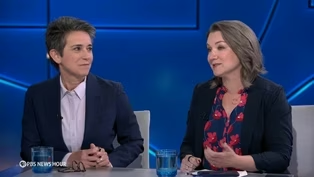
Tamara Keith and Amy Walter on redrawing congressional maps
Video has Closed Captions
Tamara Keith and Amy Walter on redrawing congressional maps and testing Trump's power (8m 14s)

Trump administration pays big bucks to abandon wind farms
Video has Closed Captions
Why the Trump administration is paying billions to abandon wind farms (3m 13s)

U.S. and Iran tested over the Strait of Hormuz
Video has Closed Captions
U.S. and Iran truce tested over the Strait of Hormuz, threatening to reignite conflict (3m 30s)

U.S. Forest Service cuts raise concerns about public lands
Video has Closed Captions
U.S. Forest Service cuts raise concerns on protecting public lands and fighting wildfires (7m 8s)

What the Supreme Court ruling means for abortion access
Video has Closed Captions
What the Supreme Court ruling means for abortion access and what comes next (5m 27s)
Providing Support for PBS.org
Learn Moreabout PBS online sponsorship
- News and Public Affairs

Today's top journalists discuss Washington's current political events and public affairs.

- News and Public Affairs

FRONTLINE is investigative journalism that questions, explains and changes our world.









 New Season

Support for PBS provided by:
Major corporate funding for the PBS News Hour is provided by BDO, BNSF, Consumer Cellular, American Cruise Lines, and Raymond James. Funding for the PBS NewsHour Weekend is provided by...