
New Documentary Explores the American Dream and How It's Changed Over Time
Clip: 7/23/2026 | 8m 35sVideo has Closed Captions
America’s 250th anniversary brings up one timeless question: What is the American Dream?
America’s 250th anniversary brings up one timeless question: What is the American Dream? The team behind a new documentary traveled all 50 states to pose that question to 1,000 people.
Problems playing video? | Closed Captioning Feedback
Problems playing video? | Closed Captioning Feedback
Chicago Tonight is a local public television program presented by WTTW
WTTW video streaming support provided by members and sponsors.
New Documentary Explores the American Dream and How It's Changed Over Time
Clip: 7/23/2026 | 8m 35sVideo has Closed Captions
America’s 250th anniversary brings up one timeless question: What is the American Dream? The team behind a new documentary traveled all 50 states to pose that question to 1,000 people.
Problems playing video? | Closed Captioning Feedback
Where to Watch Chicago Tonight
Chicago Tonight is available to stream on pbs.org and the PBS app.

WTTW News Explains
In this Emmy Award-winning series, WTTW News tackles your questions — big and small — about life in the Chicago area. Our video animations guide you through local government, city history, public utilities and everything in between.Providing Support for PBS.org
Learn Moreabout PBS online sponsorship>> America's 200 50th anniversary brings up one timeless question.
What is the American dream?
The team behind a new documentary airing on W t Tw traveled all 50 states to posed that very question to 1000 people.
Here's a look at The search for the American dream.
>> We as the American dream.
I've been looking Between the promise that had worked be enough.
What happens when hard work simply isn't enough anymore.
Over 2 years across this country.
In east to West, knocked us out.
And listen to the voice of hundreds and hundreds of everyday working Americans.
Families and farmers teaches in truck drivers, students and service workers.
>> And joining us now to talk more about the documentary are husband and wife filmmakers, David McCourt, writer, narrator and co-producer of And Julie McCord, co-producer of Thanks to both for joining us.
Welcome to Chicago tonight.
to be Thank So why did you want to create this documentary?
David, start with you.
Everybody was celebrating America's 200 50th birthday in.
>> They seem to be looking backwards.
We want to create film look forward in asked ourselves.
want America to look like for the next 2, years.
And we've had the best way to do that.
to ask Americans what do they want America to look like going forward to the film isn't our point of view.
The point is the film is America's point of view.
We need going forward.
>> 2 weeks in question you won't want to make this.
You know, it started as a conversation between us and then that conversation we realize really had to be had publicly.
So it's an unscripted.
Nobody was cast weekend.
Very good.
It just reaching out to strangers.
actually we are really good at stake in excuse me.
We just wonder what you think of the American dream.
Process to get just life altering because we talked so many different people.
We have the opportunity to really listen to stories from all over the country.
And overall, it's a conversation we want to keep going.
I mean, people talking to one another about what's on their mind, unmitigated by, you unused he or prompted by a very simple question.
What's your hope for the future?
Yeah.
>> So you know, as Americans we often think about home ownership.
And we heard a lot about the white picket fences.
And we also often think about home ownership is sort of reflecting achievements of the American dream is owning a home is apparently the American dream how why is that?
David had added we get to that.
>> I think home ownership is really embedded in America from the very beginning, even with the Homestead Act.
We gave a big piece of America to people that they would build a home and contribute to the community.
So it's an embedded what it means to be an American.
We've sort of set rules out to say if you work hard.
And you contribute community, you get to own all some people get on a big home.
Some people in a small.
But if you work you should be able to afford a home in America and Well, to the 1970's, the average home in America 3 times the average income.
And that was affordable for everyone at that level.
Today, it's 8 times the average income, but its 16 times agendas So it's not affordable for half of Americans.
And I don't.
think that's personally.
It is hard to live a dignified life.
If you know, you can never afford to own kind piece of America, the country that you love the country that you willing to work from continuing to fight for the country, willing to contribute to community for to volunteer for helps changes for you.
Can do a tiny piece of the itself.
I don't think that's a good policy personally.
you know, like you said you asked participants like what we're literally called man on the street and he you, ask them, what is the American dream?
Were you surprised by their answers?
>> And where the conversations led.
Often often.
I mean, really divers really many answers 1000 1000 people 1000.
Different answers right?
>> I was.
They're optimistic.
People have quite candid pictures into this country.
I was surprise perhaps that younger people felt less idealistic about own home ownership as a possibility.
There was a there was that was a little upsetting because in our generation, we all have a path.
We understood that we would work hard.
We may be weakened.
A small a weed.
Get to sell it and move like that cycle of it, you know, moving up economic possibilities impossible.
Now, it seems really rough.
And not to David's point, you know, their statistics that show this is not as possible is that what was and we feel that's wrong.
>> You know that conversation about home ownership, of course, that Segways into conversations about money and greed in economics.
Also technology and social media.
Some people spotting the Internet, you know, wholesale for all of our problems, the loneliness epidemic.
So you've got to know a lot of different themes and in conversations to be had here.
And it's a complicated subject for a lot of people.
The American dream has for some people.
They feel they have been denied.
What gives you hope to Lee?
>> You know, and I think we are intrinsically resilient.
I think Americans feel.
That we are, you know, we are Americans.
And so the hope there is that we will start talking to one another that we will build community, that we will stop starting allies instead of.
Bound, you know, rejection another.
I think that's a real hope for the future.
And I think there is a groundswell of people are starting to say.
Wait a minute, I want back what I felt maybe ahead as a child or maybe what my parents had and I it I do think didn't have very optimistic that the future this very possible.
But let's all get on board.
You know, let's let's try very hard to talk to one another.
then we go back to the conversation.
Can we start a conversation?
We want to get to a million voices were continuing to film.
Still working on it.
There's more to come within few 5,000. we went to 5,000 made the film 1000.
>> But we've continued turned into an entire project like an anthropological study is let's all.
Look at each other.
Let's talk to each other.
Let's engage one another.
Listen.
The benefit for us is the I was life changing to talk to mandate that many people.
It really was.
David, you also you shared some of your own family history in this documentary.
Why was that important for you to include and how do you think your family's history and story are reflected in the American dream?
>> Well, it was important for me because my family is a very typical.
American family.
There's nothing special.
I mean, we all love each other, but those nothing special.
My grandfather came in at 16 identify the didn't have education work as a janitor, which means clean.
Buildings.
toilets from the oven.
really didn't find life.
I never remember a birthday or Christmas.
What I did have a little something He owned his own home.
He raise my mother and then another 5 and raise me.
He died debt free in dignified life.
And I was able to stand on his shoulders and I'm a little bit worried.
But the year-old version of me.
I was a special night, got to live the American dream myself as my fav, the didn't.
My grandfather did.
I just hope that possible for the 18 year-old version of And that's what I hope this film does allow us to talk about that?
And if there are issues, that's all that together.
Okay.
That's a good place to leave it rats on the film and its really state injuring the court.
Thank you so much for
 New
NewChicago's Pro Pickleball Team Competes in Major League Tournament
Video has Closed Captions
The Chicago Slice will play at the four-day tournament in north suburban Northbrook. (2m 48s)
 New
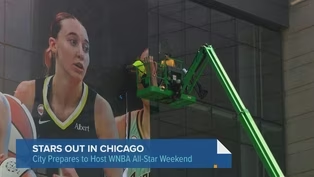
NewWhat to Expect at the 2026 WNBA All-Star Weekend in Chicago
Video has Closed Captions
Chicago will be the center of the women's sports world this weekend. (8m 42s)
Providing Support for PBS.org
Learn Moreabout PBS online sponsorship New Episode
- News and Public Affairs

Top journalists deliver compelling original analysis of the hour's headlines.

- News and Public Affairs

Today's top journalists discuss Washington's current political events and public affairs.


 New Episode
 New Episode


 New Episode

 New Episode
Support for PBS provided by:
Chicago Tonight is a local public television program presented by WTTW
WTTW video streaming support provided by members and sponsors.