
Irin Carmon joins Amna Nawaz for our 'Settle In' podcast
Clip: 12/25/2025 | 5m 6sVideo has Closed Captions
Irin Carmon joins Amna Nawaz for our 'Settle In' podcast
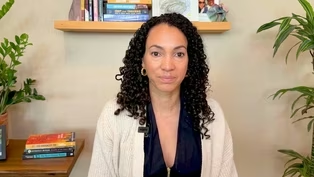
For our podcast, "Settle In," Amna Nawaz spoke with Irin Carmon, the journalist behind the book “The Notorious RBG,” as well as a new book about pregnancy in America. "Unbearable" follows the stories of five women in New York and Alabama as they navigate a new landscape following the overturning of Roe v. Wade.
Problems playing video? | Closed Captioning Feedback
Problems playing video? | Closed Captioning Feedback
Major corporate funding for the PBS News Hour is provided by BDO, BNSF, Consumer Cellular, American Cruise Lines, and Raymond James. Funding for the PBS NewsHour Weekend is provided by...
Irin Carmon joins Amna Nawaz for our 'Settle In' podcast
Clip: 12/25/2025 | 5m 6sVideo has Closed Captions
For our podcast, "Settle In," Amna Nawaz spoke with Irin Carmon, the journalist behind the book “The Notorious RBG,” as well as a new book about pregnancy in America. "Unbearable" follows the stories of five women in New York and Alabama as they navigate a new landscape following the overturning of Roe v. Wade.
Problems playing video? | Closed Captioning Feedback
How to Watch PBS News Hour
PBS News Hour is available to stream on pbs.org and the free PBS App, available on iPhone, Apple TV, Android TV, Android smartphones, Amazon Fire TV, Amazon Fire Tablet, Roku, Samsung Smart TV, and Vizio.
Providing Support for PBS.org
Learn Moreabout PBS online sponsorshipWILLIAM BRANGHAM: We turn now to our video podcast, "Settle In."
Amna Nawaz recently spoke with Irin Carmon, the journalist behind the book "The Notorious RBG," as well as a new book about pregnancy called "Unbearable."
It tells the stories of five women in New York and Alabama as they navigate a new post-Roe landscape.
Here's an excerpt of that conversation.
IRIN CARMON, Author, "Unbearable: Five Women and the Perils of Pregnancy in America": The women in my book, most of them -- some of them are pregnant more than once throughout the course of the book.
Most of them actually are not looking to end their pregnancies.
They want to keep their pregnancies.
They want to raise their children.
But as I report on in the book and as I tell their stories, which unspool over the course of before, during and after pregnancy, the way that American medicine and law has been set up has profoundly limited and harmed and cruelly treated too many people who find themselves in these situations, whether that's needing miscarriage care, whether that's having respectful and safe birth care, or whether that's seeking to end a pregnancy.
AMNA NAWAZ: The fascinating thing about the stories as you share them is that, even when you expect things to unfold in a certain way because of someone's socioeconomic status or because of where they live, some of these same things and same challenges and same treatments ring true even there.
And I want -- I'm going to unpack all of that.
I want to talk to you about some of those silos you mentioned there too.
But I have to put to you this one line when you were talking about why you wanted to write this book in the very first few pages, because this stuck with me.
You said: "What's clear to me from my years of reporting and my own experiences is how incomplete our story of American reproduction has been and how much has been unexpressed, hidden or taken for granted."
The incomplete part stuck with me.
What did you mean by that?
IRIN CARMON: Well, first of all, we can't have too many stories about what this profoundly life-changing experience can do.
I think, for me, when I -- the real inspiration for writing this book, the actual moment, even though in some ways I was leading up to it in my entire career of reporting, was being pregnant.
I was six months pregnant for the second time when Roe v. Wade was overturned with the Dobbs decision and I was eight months pregnant when the decision was finalized.
And for me, one of the stories that I wanted to tell -- I was covering the decision as a reporter at "New York Magazine."
I was writing about all the implications for policy and for law and the dynamics of the decision and the holding.
But I was also feeling in my bones what it would mean for this profound change in American law and life, how it would actually affect people.
And I did not need an abortion.
I did not seek an abortion.
I was really excited to be pregnant.
But I also found myself thinking, why hasn't anybody talked about how what an enormous physical and grave undertaking pregnancy can be in the context of even when you want to and what it might mean to force this on someone?
I don't think nobody talks about it, but for me it was something that I felt in my bones.
I felt it in my blood.
I could feel like in the extra heart that was beating inside of me, that there was a profound erasure from that opinion in particular and from the way Alito wrote about it of the seriousness of pregnancy, regardless of the circumstances you find yourself in.
So one of the parts that I thought was incomplete and inexpressed is that you might think of yourself -- unexpressed - - is that you might think of yourself as never needing this kind of care, right?
And there are women in the book who I write about who never thought they would be in this situation... AMNA NAWAZ: Right.
IRIN CARMON: ... and find themselves seeking a kind of care that is stigmatized, that is illegal, that is secret, or that they will be punished for one way or another.
And so it felt like the best way to tell that story was to -- I started a little bit by weaving in my own personal story, even though in many ways it's not an extraordinary one, but I think the very fact that for me as a married, white, upper-middle-class, privileged woman who literally reports on this for a living, the feelings that I had of being made to feel smaller or less than a fully adult human in control of my own decisions during my pregnancy were so instructive for me.
Because I thought, like, what chance does anybody who doesn't have all this going for them have in this system that says that the moment you become pregnant you have fewer constitutional rights, you have fewer rights of autonomy in medicine, you will be treated like, to quote one of the women in my book, a child animal?
And that's not to diminish the fact that my pregnancies and many other people's pregnancies were deeply joyful and I was excited about them, but that's not a reason to diminish the individual pregnant person's humanity.
WILLIAM BRANGHAM: For that full conversation and more episodes, check out our video podcast "Settle In" or on YouTube or wherever you get your podcasts.
A Brief But Spectacular take on resilience and rebuilding
Video has Closed Captions
Clip: 12/25/2025 | 4m 9s | A Brief But Spectacular take on putting the pieces back together (4m 9s)

How the traditions of Santa Claus evolved over centuries
Video has Closed Captions
Clip: 12/25/2025 | 5m 44s | How the character and traditions of Santa Claus evolved over centuries (5m 44s)

News Wrap: Zelenskyy speaks with U.S. peace negotiators
Video has Closed Captions
Clip: 12/25/2025 | 3m 36s | News Wrap: Zelenskyy says he had 'good conversation' with U.S. negotiators on peace plan (3m 36s)

Rain drenches Southern California with more storms coming
Video has Closed Captions
Clip: 12/25/2025 | 2m 39s | Torrential rains drench Southern California with more storms on the way (2m 39s)

The Rockettes celebrate a century of dance
Video has Closed Captions
Clip: 12/25/2025 | 3m 46s | The Rockettes celebrate 100 years as a holiday season favorite (3m 46s)
Providing Support for PBS.org
Learn Moreabout PBS online sponsorship
- News and Public Affairs

FRONTLINE is investigative journalism that questions, explains and changes our world.

- News and Public Affairs

Amanpour and Company features conversations with leaders and decision makers.












Support for PBS provided by:
Major corporate funding for the PBS News Hour is provided by BDO, BNSF, Consumer Cellular, American Cruise Lines, and Raymond James. Funding for the PBS NewsHour Weekend is provided by...