
Wisconsin Farm Turns Manure into Energy
Clip: 5/18/2026 | 4m 22sVideo has Closed Captions
See how a Wisconsin dairy farm turns cow manure into an energy source.
See how a Wisconsin dairy farm turns cow manure into an energy source.
Problems playing video? | Closed Captioning Feedback
Problems playing video? | Closed Captioning Feedback
America's Heartland is presented by your local public television station.
Funding for America’s Heartland is provided by US Soy, Sustainable Agriculture Research and Education, Rural Development Partners, and a Specialty Crop Grant from the California Department of Food and Agriculture.
Wisconsin Farm Turns Manure into Energy
Clip: 5/18/2026 | 4m 22sVideo has Closed Captions
See how a Wisconsin dairy farm turns cow manure into an energy source.
Problems playing video? | Closed Captioning Feedback
How to Watch America's Heartland
America's Heartland is available to stream on pbs.org and the free PBS App, available on iPhone, Apple TV, Android TV, Android smartphones, Amazon Fire TV, Amazon Fire Tablet, Roku, Samsung Smart TV, LG TV, and Vizio.
Providing Support for PBS.org
Learn Moreabout PBS online sponsorship>> There is no doubt that questions about farming and the environment have had a higher profile in recent years.
We've brought you any number of stories on farmers and ranchers addressing things like water quality, air pollution, or the use of pesticides.
And if you're running a dairy farm, there is the ever present question of all that manure.
Well, our Sarah Gardner met one farm family in Wisconsin with a "powerful" solution.
Moo >> The power used to make cheese is more than just a "drop" in the bucket on a dairy farm.
>> We have a very big electric bill here at the cheese factory and the farm pumping water, so we use a lot of energy on the farm and the cheese factory.
>> When electricity bills began running more than six thousand dollars a month, Crave Brothers Dairy decided to take their cattle waste and convert it to "green energy".
>> The cows produce the manure.
>> That manure, fermented through the use of enzymes, releases methane gas, which in turn fuels engines that generate electricity.
>> Green energy is produced here.
We offset our electric needs for both our farm, our cheese factory, and in addition we supply enough for about 300 area homes.
>> The "waste to energy" process takes place in a large machine called a digester that sits on the Crave Brothers property.
>> The Craves invested about four million dollars in the project, a partnership with Clear Horizons, a Wisconsin company that specializes in green technology.
>> But electricity isn't the only product the digester provides.
>> It also separates the liquids from the remaining solids in the manure creating a highly nutritious fertilizer.
>> The sustainable process allows the Crave Brothers to focus a product that Wisconsin is well known for making cheese from pasteurized milk.
>> Then it goes into those big vats that holds 25 thousand pounds of milk per vat.
It's heated up in those vats to about 105 degrees where we add the rennet that coagulates the milk.
It turns into a large mass, almost like yogurt.
And that's cut into the cubes of curds and whey.
>> Well, this where the curds and whey come down out of the cheese vats.
And they flow with the whey, which is about 90 percent of the product is the whey.
10 percent is just the curd.
And it comes down here.
And we drain the whey off of the table here with a screen.
See the screen is a big drain.
And the curd is left over.
And from here we load the curd into the mozzarella cooker that melts it to about 120 degrees where it's very pliable and we can mold it into different sizes and shapes of mozzarella that we have the orders for.
>>How many different types of products do you make?
>> We make four main cheeses.
We make fresh mozzarella, Mascarpone cream cheese, part skim mozzarella or Queso Oaxaca.
and then our farmstead signature Le fromage de Freres or French for "the brothers cheese."
>> The family's products have won a number of awards, something the brothers hope will inspire the next generation to take over the family business.
>> That's our goal is to have any one of the children, herdsman, crop manager, veterinarian, business person, cheese operator, and marketing.
There's a lot of opportunity here that we've created in this family business >> And a chance to benefit the environment one ball of mozzarella at a time.
>> It's hasn't been any big master plan over 20 years.
It's always been, what's next?
What are we going to try and do in the next two or three years?
What do we need to do next week?
And that's how we approach our business.
>> Cheese has been around for a long, long time.
In fact, you'll find pictures of cheese making decorating the walls of early Egyptian architecture.
Ever wonder about the most popular variety of cheese?
Well, cheddar, named after a village in England, wears the crown.
And depending on where you live, that cheddar may be white or yellow.
Both are popular in the U.S.
and Canada.
 New
NewVideo has Closed Captions
On Farm to Fork, fun with fungi and a special recipe for pasta. (6m 56s)
 New
NewVideo has Closed Captions
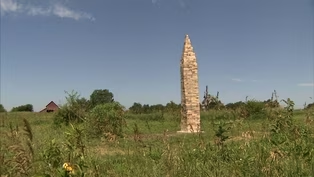
Travel to Nebraska where artists find rural life peaceful and inspiring to their creative work. (5m 41s)
 New
NewUrban Visitors Take "Haycations"
Video has Closed Captions
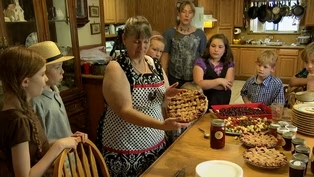
Discover how Farm Stay vacations are giving city kids a chance to discover rural America. (5m 29s)
Providing Support for PBS.org
Learn Moreabout PBS online sponsorship
- Food
Christopher Kimball’s Milk Street Television
Transform home cooking with the editors of Christopher Kimball’s Milk Street Magazine.










Support for PBS provided by:
America's Heartland is presented by your local public television station.
Funding for America’s Heartland is provided by US Soy, Sustainable Agriculture Research and Education, Rural Development Partners, and a Specialty Crop Grant from the California Department of Food and Agriculture.