
City Kids, Rural Life
5/18/2026 | 26m 30sVideo has Closed Captions
Farm stays shows city kids rural life. Mushroom pasta recipe. Dairy turns cow manure into energy.
Discover how Farm Stay vacations are giving city kids a chance to discover rural America. Call them “hay-cations.” On Farm to Fork, fun with fungi and a special recipe for pasta. See how a Wisconsin dairy farm turns cow manure into an energy source. And travel to Nebraska where artists find rural life peaceful and inspiring to their creative work.
Problems playing video? | Closed Captioning Feedback
Problems playing video? | Closed Captioning Feedback
America's Heartland is presented by your local public television station.
Funding for America’s Heartland is provided by US Soy, Sustainable Agriculture Research and Education, Rural Development Partners, and a Specialty Crop Grant from the California Department of Food and Agriculture.
City Kids, Rural Life
5/18/2026 | 26m 30sVideo has Closed Captions
Discover how Farm Stay vacations are giving city kids a chance to discover rural America. Call them “hay-cations.” On Farm to Fork, fun with fungi and a special recipe for pasta. See how a Wisconsin dairy farm turns cow manure into an energy source. And travel to Nebraska where artists find rural life peaceful and inspiring to their creative work.
Problems playing video? | Closed Captioning Feedback
How to Watch America's Heartland
America's Heartland is available to stream on pbs.org and the free PBS App, available on iPhone, Apple TV, Android TV, Android smartphones, Amazon Fire TV, Amazon Fire Tablet, Roku, Samsung Smart TV, LG TV, and Vizio.
Providing Support for PBS.org
Learn Moreabout PBS online sponsorship>> Hi I'm Rob Stewart.
We have quite a variety for you on America's Heartland this time.
Making the most of manure in Wisconsin.
Mixing art and agriculture in Nebraska and taking a short vacation in California Gold Country.
Call it a "great escape" to the country.
Farm Stay vacations give city folks the chance to experience life in rural America.
And better understand what it takes to bring food from farm to table.
Sharon Profis is having some fun with fungi in our Farm to Fork Segment.
Sharon's serving up some flavorful pasta with mushrooms.
We'll see how some artists are honing their skills with a unique art program in rural Nebraska.
And our Sarah Gardner introduces you to a Wisconsin Dairy farming family... turning waste from their cows into electricity for the farm.
It's all coming up on America's Heartland.
>> America's Heartland is made possible by: >> America never stops.
Neither do the farmers and ranchers who call her home.
And as rural America grows further, Farm Credit will be there, just as we have for 100 years.
>> CropLife America, representing the companies whose modern farming innovations help America's farmers provide nutritious food for communities around the globe.
>> The Fund for Agriculture Education.
A fund created by KVIE to support America's Heartland programming.
Contributors include the following: ♪ You can see it in the eyes of every woman and man.
♪ ♪ In America's Heartland, living close to the land.
♪ ♪ There's a love for the country and a pride in the brand.
♪ ♪ In America's Heartland, living close, ♪ ♪ close to the land >> Thanks for joining us on America's Heartland.
Spending some time in the country can have real benefits for both visitors and those who make their home in rural America.
We'll mix art and agriculture later in the show, but let's start out with what some folks call Haycations.
It's estimated that eight to ten percent of American farms and ranches offer some kind of agritourism experience for visitors.
The farmers and ranchers will tell you that it's not only a good way to bring in added income; it's also a way for city folks to learn a little more about agriculture.
Vacations are a chance to do something different.
And for some folks that means time down on the farm.
>> Travel down this rural road in California Gold Country and you'll find Willow Creek Ranch, 40 acres of farm stay-cation in Mountain Ranch, CA >> Willow Creek is a spot where visitors from around the globe have left urban life behind for some different experiences down on the farm.
>> In this case, youngsters looking for a chance to milk a cow are glued to a "hands on" lesson from Willow Creek owner John Orr.
>> I get a blast out of teaching kids.
I mean, it, I don't know if it's teaching or not, but... >> Well they're certainly learning.
>> They, they've never seen anything like this before in their life.
>> And to show them how it used to be done... >> Yeah... >> By hand, how hard that would have been years ago... >> Yeah, yeah.
Well you know that's, that's our focus.
>> Visitors to Willow Creek will come for a day, a week, or even longer.
They're drawn to the colorful history of the area and drawn to a much more leisurely pace of life.
>>Now I need to get over here cause I have be next to it.
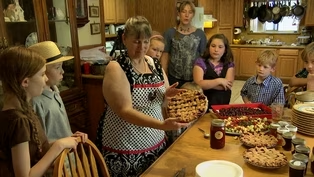
On this summer afternoon, farmer Cathie Orr is in the kitchen turning fresh cow's milk into homemade yogurt.
>> This is going to, it's going to cook for 8 hours, it's going to cool for 8 hours, and then I'm going to pour it up into this, move, I'm going to pour it up into this right here, and I'm going to put in refrigerator and strain it, and it'd look like this.
>> Wow... >> Then, the best part, time to taste the farm fresh creation.
>> It was in the cow yesterday!
>>That's delicious!
>> So thats what I do... >> That is so fresh!
>> But Cathie's pies are the star attraction today.
The night before we arrived, Cathie canned 200 pounds of cherries.
Today, Cathie's using the sweet fruit in her farm kitchen lessons, helping the youngsters put them on top of her just made yogurt.
>> This is what you call Farm to Fork.
>> This is real life Farm to Fork.
>> Real life.
>> Farm to fork connections like these are happening with increasing frequency around the globe.
There are a number of online sites connecting vacationers with farms and ranches offering long or short duration holidays.
Visitors say the vacations allow them to connect with rural America and have a better understanding of where their food is coming from.
>> I think it's an antidote, I think it's an antidote to, to all of the big pressure that we're under all the time now, to be productive, and this is not your regular um, experience, it's not your regular vacation.
>>Might have to do what's called a chicken elevator.
>> It's memories, you know, really, you could do a lot of different things, you could spend money, in a lot of different ways but you can't really often guarantee memories for the family, you know what I mean, so that's, that's why I wanted to do it.
>> I think it was really fun and um, I think it's important to learn about this stuff.
>> And the visit here includes a bit of history as well, with a tour to a 19th century gold mine.
>>This mine was dug like I say about 1860.
>>It's those life changing experiences that draw many to vacations in the heartland.
Vacations that also give farm and ranch families a chance to share their lives with people from around the world.
>>I'm meeting people from Belgium, I'm meeting people from South Africa, I'm meeting people from India, I'm meeting people from China, and I'm getting all this culture and, and, and it's just blowing my head all to smithereens because it's just so neat, it's like going there, I love it!
>> There are so many kids here today.
These are experiences that they will not forget, and you helped make that.
>> That's important.
I enjoyed going to my grandmother's farm because she was, she had a farm and a cow and milked the cow, I wasn't involved in it much but I enjoyed, and even now, we're trying to recreate what she had in the '40s.
I want people to come here and feel like they went to grandma's.
♪♪ >> Willow creek Ranch sits in the heart of California gold country, but California wasn't the first state to have a "gold rush".
Some 50 years earlier, a 17 pound gold nugget discovered in North Carolina kicked off a gold rush in that state.
For more than 30 years gold coins issued by the U.S.
Mint were produced from North Carolina gold.
>> There is no doubt that questions about farming and the environment have had a higher profile in recent years.
We've brought you any number of stories on farmers and ranchers addressing things like water quality, air pollution, or the use of pesticides.
And if you're running a dairy farm, there is the ever present question of all that manure.
Well, our Sarah Gardner met one farm family in Wisconsin with a "powerful" solution.
Moo >> The power used to make cheese is more than just a "drop" in the bucket on a dairy farm.
>> We have a very big electric bill here at the cheese factory and the farm pumping water, so we use a lot of energy on the farm and the cheese factory.
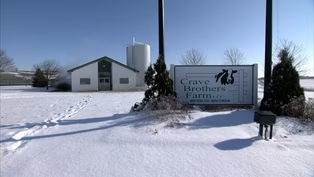
>> When electricity bills began running more than six thousand dollars a month, Crave Brothers Dairy decided to take their cattle waste and convert it to "green energy".
>> The cows produce the manure.
>> That manure, fermented through the use of enzymes, releases methane gas, which in turn fuels engines that generate electricity.
>> Green energy is produced here.
We offset our electric needs for both our farm, our cheese factory, and in addition we supply enough for about 300 area homes.
>> The "waste to energy" process takes place in a large machine called a digester that sits on the Crave Brothers property.
>> The Craves invested about four million dollars in the project, a partnership with Clear Horizons, a Wisconsin company that specializes in green technology.
>> But electricity isn't the only product the digester provides.
>> It also separates the liquids from the remaining solids in the manure creating a highly nutritious fertilizer.
>> The sustainable process allows the Crave Brothers to focus a product that Wisconsin is well known for making cheese from pasteurized milk.
>> Then it goes into those big vats that holds 25 thousand pounds of milk per vat.
It's heated up in those vats to about 105 degrees where we add the rennet that coagulates the milk.
It turns into a large mass, almost like yogurt.
And that's cut into the cubes of curds and whey.
>> Well, this where the curds and whey come down out of the cheese vats.
And they flow with the whey, which is about 90 percent of the product is the whey.
10 percent is just the curd.
And it comes down here.
And we drain the whey off of the table here with a screen.
See the screen is a big drain.
And the curd is left over.
And from here we load the curd into the mozzarella cooker that melts it to about 120 degrees where it's very pliable and we can mold it into different sizes and shapes of mozzarella that we have the orders for.
>>How many different types of products do you make?
>> We make four main cheeses.
We make fresh mozzarella, Mascarpone cream cheese, part skim mozzarella or Queso Oaxaca.
and then our farmstead signature Le fromage de Freres or French for "the brothers cheese."
>> The family's products have won a number of awards, something the brothers hope will inspire the next generation to take over the family business.
>> That's our goal is to have any one of the children, herdsman, crop manager, veterinarian, business person, cheese operator, and marketing.
There's a lot of opportunity here that we've created in this family business >> And a chance to benefit the environment one ball of mozzarella at a time.
>> It's hasn't been any big master plan over 20 years.
It's always been, what's next?
What are we going to try and do in the next two or three years?
What do we need to do next week?
And that's how we approach our business.
>> Cheese has been around for a long, long time.
In fact, you'll find pictures of cheese making decorating the walls of early Egyptian architecture.
Ever wonder about the most popular variety of cheese?
Well, cheddar, named after a village in England, wears the crown.
And depending on where you live, that cheddar may be white or yellow.
Both are popular in the U.S.
and Canada.
>> Let's make a farm to table connection right now for you, your family or friends.
Lots of you who connect with us on Facebook or send along emails to our America's Heartland website tell us how much you enjoy the special recipes from Sharon Profis in our Farm to Fork segments.
I think it reflects how much food and food issues have taken on a viral voice these days.
Well, Sharon's back in the kitchen.
This time with flavorful mushroom pasta.
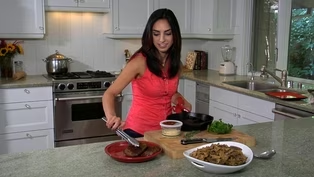
♪♪ >> If you're looking to take a break from meat, mushrooms are the ideal substitute.
They've got a meaty texture, they're savory, and they're willing to take on just about any flavor you throw at them.
♪♪ So what I've got here for our wild mushroom pasta are three different types of mushrooms.
So, cremini, which I'm chopping right now, and you'll see I'm not removing the stems, because cremini mushrooms actually don't have very woody stems, so you can actually eat them.
I'm also using oyster mushrooms, which have a more delicate flavor, and porcini mushrooms.
With these porcini mushrooms, I had to reconstitute them because they were dry.
And to do that, I put them in a bowl of hot water and let them sit there for about twenty minutes.
Then I actually reserved that water, and you'll see why in just a few minutes.
But first we need to prepare the rest of our components, so, leeks, which have a nice delicate flavor that goes really well with mushrooms.
And of course, garlic.
>> Mushrooms and garlic are a great combination.
So our prep is done, and now it's time to head to the stove.
So the first thing we want to do is sauté the mushrooms.
>> Now, to the olive oil I'm going to add some butter, just so that I can get the high cooking temperature from the olive oil but that flavor of the butter.
The first mushrooms I'm going to add are the cremini mushrooms, because they're a little meatier and they'll require a little bit more cooking time.
So the creminis have browned a bit, now we'll add our oysters and porcinis, now we'll remove these, they reduced a ton.
Put them in a bowl, and now it's time to prep our leeks and garlic, so I'll lower the heat a bit, add some more olive oil, throw in those leeks.
And I can hear my water's boiling for our pasta.
So I'm going to add pappardelle pasta, which is a wider pasta, and I like to go with a wider pasta like pappardelle or fettuccine, because it allows the mushrooms to shine and boil them until they're al dente, not completely soft, because we're going to finish cooking them here in this pan with the mushroom and the leeks.
>> Our leeks look good, they're picking up some of that flavor from the mushrooms we sautéed in there, hit it with a little salt, now let's get these mushrooms back in.
And now we have to spice this dish.
♪♪ I mentioned that there was a reason why I saved that porcini mushroom liquid.
>> First I'm going to add a little flour, because it's time to build our sauce, so once the flour has coated these ingredients, it's time to add that liquid from the reconstituted porcini.
So I've got half of that, plus chicken stock.
>> And once that simmers it'll thicken because of the flour that we added.
So our sauce has thickened, it's kind of like a gravy now.
And now it's time to add the pasta.
We brought in some of that pasta water to further enhance this sauce.
>> We're adding two types of cheese.
We've got fontina, which is a great melting cheese, and parmesan cheese.
Our wild mushroom pasta looks good, and now it's time to plate it.
I could eat this right this second, but I do want to add a few finishing touches to it.
But before I do that, let's talk about portabella mushrooms.
These are some of the biggest mushrooms you'll find in grocery stores.
First I'm going to put some slits in these, and by adding these slits they're going to soak up a little bit more of the marinade we're going to make.
Now we'll take each portabella and coat it in this mixture, and we'll let them sit for about ten, fifteen minutes so they can really absorb that flavor.
Remember, mushrooms will take just about any flavor you give them and this is going to be delicious.
Our portabellas have soaked up all of those delicious spices and that olive oil, and now it's time to grill them on our cast iron.
>> So if you have a barbecue or a grill at home, these go great on that too.
But if you're trying to make dinner in a pinch, and all you've got is a stove-top, this will work.
So add a little bit of olive oil, then we'll add our portabellas straight to the pan.
We'll give them about four to five minutes on each side, flip them halfway through, and they'll be good to go.
Nice and dark brown, you can see they shrunk a little bit, but not quite as much as the smaller varieties do.
And now, they're ready to be put in a burger, you can slice them up and put them in tacos, or you can eat them as is, as a side dish.
Now I mentioned we had one final finishing touch for the pasta.
So what I want to do there is add a little bit of fresh parsley, I'll also add more cheese, and for a garnish, a little sprig of thyme.
We've cooked with four types of mushrooms today, oyster, porcini, cremini, and of course, the king of the mushrooms, portabella.
And with so many varieties to choose from, mushrooms make for a great meatless meal.
♪♪ >> Take your pick: There are several thousand varieties of mushrooms growing in the United States, but only a few hundred are thought to be "safely" edible.
And a word about "toadstools".
The word was once used interchangeably by some cultures in identifying certain mushrooms.
Today, the word "toadstool" is often used to describe examples of "poisonous" mushrooms >> We started the show with a family getaway to the country.
Let's meet some artists for whom time in the heartland is having a real impact on their work.
It's all part of a program that seeks to encourage and inspire young artists in a rural setting.
Our Akiba Howard takes us to the Nebraska Art Farm.
♪♪ >> There are images and sounds we usually associate with life in the heartland... >> But there are also, images and sounds that make some places unique.
>>Here's space, do what you want.
And you don't have to worry about someone looking over your shoulder.
If you are doing this you can experiment.
I encourage experimentation.
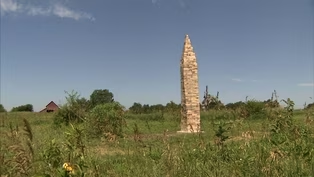
>>Welcome to the art farm.
>> Created in 1993, this artistic enclave sits on half of Ed Dadey's farm a couple hours west of Omaha.
Ed's nephew works the "production" side of this land - growing corn and soybeans.
And while that farm work goes on, visiting artists spend their time appreciating the rhythms of rural life.
>> That's sort of typical the way artists work around here.
Like, long periods of thought, trying to go through the process.
It's the reason why I sort of recommend they come for two months, cause it takes one month to get through all the other stuff.
Then they work.
>> On this late spring morning, a poet and two painters have immersed themselves in the farm's creative atmosphere.
>> On the website Art Farm seemed kind of like strange and adventurous.
Not like your average residency.
>> 29-year-old Rebecca Johnson is an impressionist artist from Asheville, North Carolina.
The Art Farm gives her a window on a world that's different from her usual environment.
>> And there's just something strange and amazing about walking down a dirt road and just being able to see for miles and knowing that like you can walk and walk all day, and you'll be on that same dirt road and it'll pretty much look the same.
>> 24-year-old Amy DiPlacido traveled 1600 miles from Middleton, Massachusetts.
She found the pace of the farm fueled her passion for linear art.
>> It really slows you down here.
I think that's really important to learn too, especially coming from the city and just knowing like the hustle and bustle it doesn't really matter.
>> The geography also inspired her artwork of straight lines.
>> And seeing those lines of cornfields and soybeans.
And you can see right down, everything's placed in a grid.
So, I'm very inspired by these man made geographical lines on the landscape.
>> Sycamore.
Lone mare under the arched limb.
Here a list of yellow things.
>> For poet Meredith Clark of Seattle, the Art Farm offered a new look at her view of writing.
>> I think it's been a real life changing experience in a lot of ways.
Learning an awful lot about the way that I work.
You know I think a lot of people make the mistake sometimes of coming to a residency assuming that they're going to turn something out.
>> She also had to learn the "process" of printing her poetry... the old fashioned way.
>> This has probably taken me an hour and a half to two hours.
And it's just six lines of type.
>> The Art Farm has welcomed artists from 10 different countries.
Space is limited to fewer than two dozen residencies a year.
And in exchange for room and board the artisans help work the farm.
A current project is restoring old barns which see duty as studios and living quarters.
>> On this day, an old bathtub became a spa of sorts.
>> And it gets hot here during the day, so we're going to fill it up when we need to cool off.
Jump in the tub, go back to our studio and work.
We're already doing that with the hose occasionaly but this will be better.
>> The landscape has become a repository of artwork completed by previous residents.
>> Carole and Bernard Smith say they make the pilgrimage from Indiana on a regular basis to see what's new.
>> I remember when Ed first started this and it was "How's he going to get people to come here?"
But it just never stops.
I mean it just seems like every year he's got more and more and more.
And it's wonderful.
>> Perhaps it's the liberation of open space, perhaps it's the serenity to be found here.
Ed and the artists will tell you it's inspiration without encumbrance.
>> It's the experience that you can try something, you can experiment and not worry about failing.
♪♪ >> Hey, just a reminder that you can find out lots more about agriculture at our website.
It's easy to find us online at AmericasHeartland.org.
And, of course, we love to keep in touch with you at some of your other favorite sites.
You can find us on Facebook, and find lots of videos from our show at the America's Heartland Channel on YouTube.
That's going to do it for us this time.
Thanks for traveling the country with us on America's Heartland.
♪ You can see it in the eyes of every woman and man.
♪ ♪ In America's Heartland, living close to the land.
♪ ♪ There's a love for the country and a pride in the brand.
♪ ♪ In America's Heartland, living close, ♪ ♪ close to the land >> America's Heartland is made possible by: >> America never stops.
Neither do the farmers and ranchers who call her home.
And as rural America grows further, Farm Credit will be there, just as we have for 100 years.
>> CropLife America, representing the companies whose modern farming innovations help America's farmers provide nutritious food for communities around the globe.
>> The Fund for Agriculture Education.
A fund created by KVIE to support America's Heartland programming.
Contributors include the following:
 New
NewVideo has Closed Captions
On Farm to Fork, fun with fungi and a special recipe for pasta. (6m 56s)
 New
NewVideo has Closed Captions
Travel to Nebraska where artists find rural life peaceful and inspiring to their creative work. (5m 41s)
 New
NewUrban Visitors Take "Haycations"
Video has Closed Captions
Discover how Farm Stay vacations are giving city kids a chance to discover rural America. (5m 29s)
 New
NewWisconsin Farm Turns Manure into Energy
Video has Closed Captions
See how a Wisconsin dairy farm turns cow manure into an energy source. (4m 22s)
Providing Support for PBS.org
Learn Moreabout PBS online sponsorship
- Food
Christopher Kimball’s Milk Street Television
Transform home cooking with the editors of Christopher Kimball’s Milk Street Magazine.




Support for PBS provided by:
America's Heartland is presented by your local public television station.
Funding for America’s Heartland is provided by US Soy, Sustainable Agriculture Research and Education, Rural Development Partners, and a Specialty Crop Grant from the California Department of Food and Agriculture.